
AI Code Review Tools in 2026: Pick the Tool for the Bug You Have

Anthony Wentzel
Founder, Pineapples
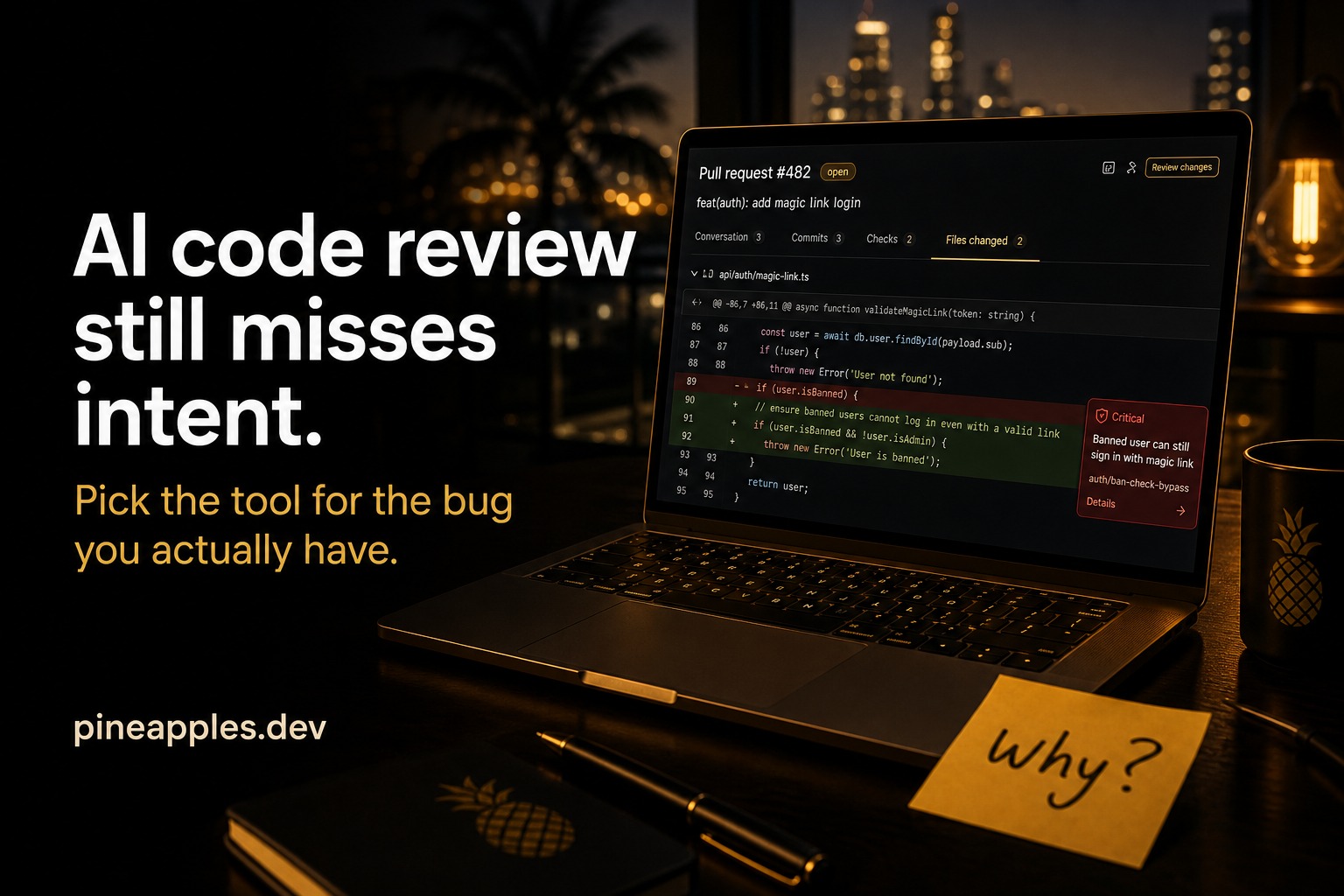
AI code review tools are good at consistent security and style findings on every pull request. They still miss intent: why the change exists, whether the design is right, and what the system is supposed to do. Pick the tool for the bug class you actually have, then keep a human on architecture and why.
That is the whole buying decision. The rest of this page is how to apply it without a fake winner board.
What is an AI code review tool?
An AI code review tool reads a diff and writes findings the way a teammate would, except it runs on every pull request with the same rules. Some of that is classic static analysis with a new label. Some of it is a model summarizing a diff or guessing a missing check. Buyers should ask which of those actually runs, not whether the landing page says AI.
The job is narrow:
- Catch the same security pattern every time, not only when someone is fresh.
- Enforce style and smell rules so humans stop spending review time on nits.
- Leave a comment on the line, in the PR, before merge.
The job is not:
- Decide if this is the right feature.
- Judge whether the architecture will hold the next year of load.
- Notice that the code is correct and still does the wrong business thing.
I have watched teams buy a review product, turn on every rule, and then ignore the comment stream. That is not a model failure. That is a job-to-be-done failure. The tool was asked to replace judgment. It can only replace repetition.
If you are placing this in a wider delivery model, start with the AI-native software delivery pillar. Review is one gate. It is not the operating model.
Which AI code review tools belong in 2026?
Name the products people actually put on a shortlist. I am not going to invent win rates, detection percentages, or a study. If a vendor will not show you findings on your last twenty pull requests, you do not have a comparison. You have a demo.
Snyk Code
What it is for: first-party security findings. Insecure patterns, tainted data, the class of bugs that become an incident.
Evaluate Snyk Code when the pain is vulnerabilities in the code you write, not only in dependencies. It is an AI code review security product first. It is a poor answer if your real problem is inconsistent naming and long methods.
GitHub
What it is for: review that already lives on the pull request.
If the repo is on GitHub, you will evaluate native scanning, secret detection, dependency alerts, and branch protection before you add another vendor. The advantage is friction. The PR is already the workspace. The risk is assuming "we are on GitHub" means security and quality are covered. They are only covered if you turned the scanners on and made a gate that can fail.
SonarQube
What it is for: smells, bugs that static analysis can see, coverage, and a quality gate in CI.
Evaluate SonarQube when the pain is drift. Every repo looks different. Reviews argue about style. Nobody can say what "good enough" means at merge. This is the AI code analysis seat on most mid-market shortlists. It is not your only security program, even when the vendor adds AI copy.
Amazon CodeGuru
What it is for: teams already inside AWS who want a reviewer next to the services they already pay for.
You will see CodeGuru in the same conversation as Amazon Q Developer. Evaluate it when the code and the cloud account are already coupled. Skip it as a first buy if your stack is GitHub plus a generic CI runner and you do not want another AWS console to babysit.
GitHub Copilot
What it is for: comments while you write, and extra eyes on a diff you already understand.
Copilot is an authoring tool that can also review. That is a different job from a scanner that must run on every PR and can fail the build. Use it to catch local mistakes early. Do not treat a Copilot comment as a security gate.
Codacy
What it is for: hosted quality, coverage, and static analysis on the PR, with AI-assisted suggestions.
Evaluate Codacy when you want a quality layer you do not have to operate, and SonarQube feels like more platform than you need. Same rule as SonarQube: this is smells and consistency, not a substitute for a security scanner.
If two tools claim the same job, run both on the same recent pull requests. Keep the one whose comments your team will actually fix. Throw out the one that files noise.
How do I choose: security vs smells vs intent?
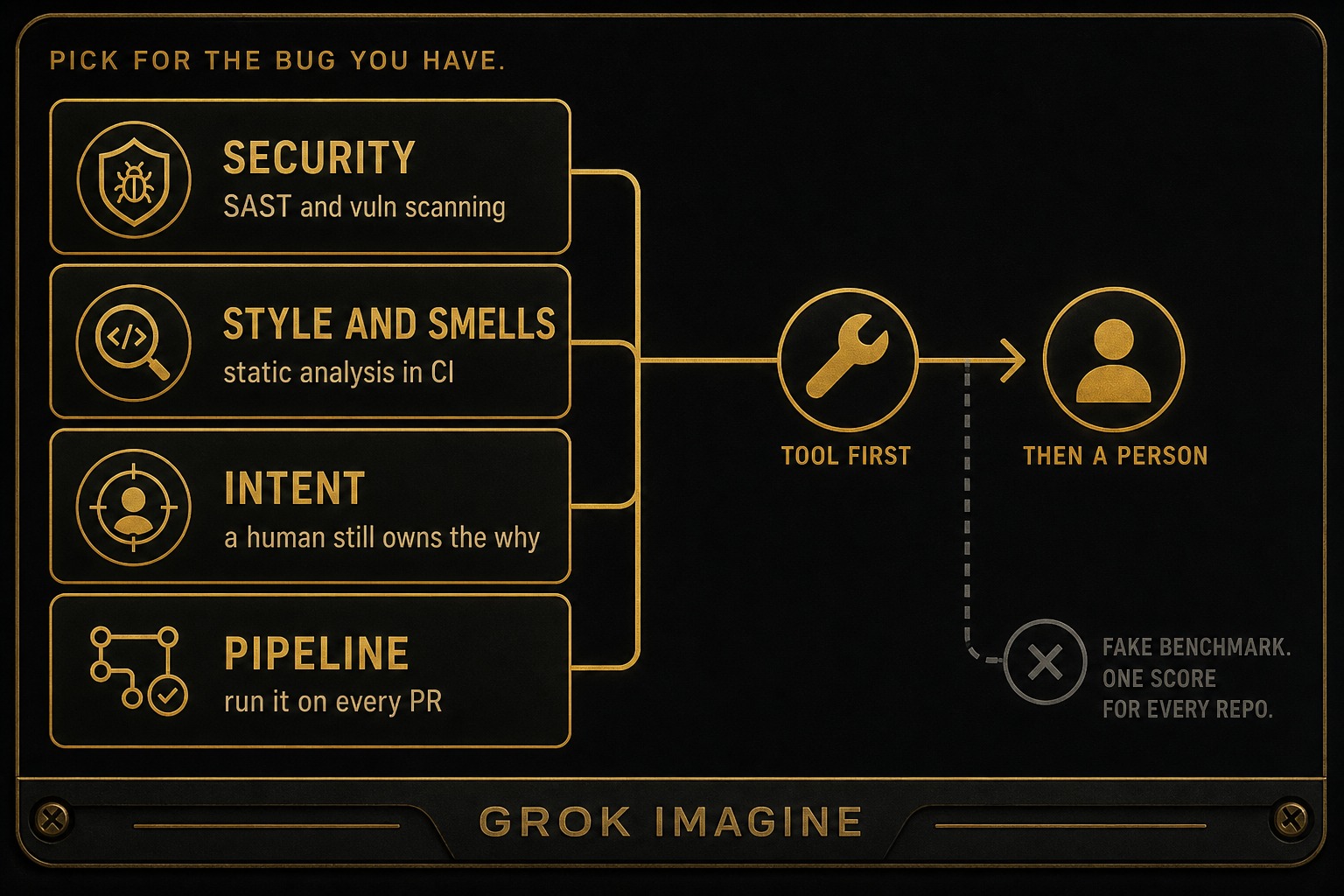
Choose the bug class first. The vendor second.
Security. The bugs that become incidents: auth bypass, injection, secrets, unsafe deserialization, missing checks on a trusted path. You want a scanner that speaks that language and can fail CI. Snyk Code and GitHub code scanning belong in this column.
Style and smells. The bugs that make the next change expensive: dead code, duplicated logic, complexity, inconsistent patterns. You want a quality gate the team agrees on. SonarQube and Codacy belong here.
Intent. The bugs no linter owns: this change is correct and still wrong. The API does what the ticket said and not what the customer needs. The "admin or banned" check was rewritten and nobody asked why. A person owns that.
Pipeline. Whatever you pick has to run on every PR. A tool that only runs when someone remembers to open the dashboard is a report, not a review.
Do not buy a single score for every repo. Repos do not share a bug class. A billing service and a marketing site should not share one vanity grade.
A practical sequence for a mid-market team:
- Write down the last five production defects that hurt. Security, smell, or intent.
- Shortlist one tool in that column. Two if you are comparing.
- Run them on those defects' pull requests, or on the files that contained the bug.
- Keep the tool that would have left a comment a human would have acted on.
- Leave intent with a named reviewer. Do not automate the why.
Related buying pages in this cluster: AI workflow automation tools and AI consulting services for mid-market. Those are about systems and partners. This page is only the review gate.
Can an AI code review tool replace a human reviewer?
No.
A tool is consistent. It does not get tired on Friday. It will flag the same insecure helper in the twentieth file. That is the win.
A person still has to answer:
- Should we build this at all?
- Does this design lock us into a cost we cannot afford later?
- Did we change auth, money, or customer data in a way the ticket never named?
- Is the test proving the behavior we care about, or only the behavior that was easy to mock?
The worst setup I see is a required AI review and an optional human. The model leaves forty comments. The author clicks through them. Nobody who understands the system looks at the diff. You paid for a rubber stamp with better grammar.
The working setup is the opposite. The tool is required and boring. The human is required on the small set of changes that can hurt: auth, data, money, public contracts, anything that crosses a service boundary. Everyone else gets a faster review because the nits are already gone.
If your team is moving toward agents that open their own PRs, this split matters more, not less. An agent will happily address style comments. It will not notice that the feature is the wrong feature. Keep a human on architecture and why. The AI-native delivery pillar is the longer version of that argument.
How should a mid-market team put AI code review in CI?
Keep the rollout small enough that people still read the comments.
Week one. Pick one repository that already ships. Turn on one tool that matches the bug class you named. Do not turn on every rule.
The gate. Fail the build on high-severity security. Do not fail the build on style on day one unless the team already agrees on the style. A red X that nobody believes trains people to bypass the pipeline.
The human. Keep review required for auth, data, money, and public API changes. Write that in the branch rules, not in a wiki.
The noise check. After two weeks, look at comments that were left open or marked "won't fix." If that pile is large, you did not get a quality program. You got alert fatigue. Turn rules off until the remaining comments are ones you would fix yourself.
Ownership. One person owns the tool the way they would own the test suite. When it breaks, it is their pager, not a group chat.
Cost. Count seats, scan minutes, and the time people spend arguing with the bot. If the bot costs more attention than the bugs it prevents, you chose the wrong column, or you turned on too much.
You do not need a transformation program. You need a gate that runs, a person who still asks why, and a shortlist that matches the bugs you actually have.
If you want a second set of eyes on the pipeline, not a slide about AI strategy, open chat or book a working session.
Related reading
Pillar guide: AI-Native Software Delivery for Mid-Market
Closely related in this cluster:
Frequently asked questions
What is an AI code review tool?
An AI code review tool reads a pull request and leaves findings the way a reviewer would, except it runs on every PR with the same rules. The useful ones are consistent on security patterns and style. They still miss intent, which is why the change exists, whether the design is right, and what the system is supposed to do.
Which AI code review tools belong on a 2026 shortlist?
The tools mid-market teams actually evaluate are Snyk Code for first-party security findings, GitHub for native scanning on the PR you already have, SonarQube for smells and quality gates, Amazon CodeGuru when the work already lives in AWS, Copilot for comments while you write, and Codacy as a hosted quality layer. None of those is a winner for every bug class. Pick the category that matches the bugs you actually ship.
How do I choose an AI code review tool for security vs smells vs intent?
Start with the bug class, not a vendor scoreboard. If the pain is vulnerabilities in first-party code, evaluate a security scanner such as Snyk Code or GitHub code scanning. If the pain is inconsistent style and maintainability, evaluate SonarQube or Codacy. If the pain is wrong design or a change that does the wrong thing on purpose, that is intent, and a human still owns it.
Can an AI code review tool replace a human reviewer?
No. A tool is consistent and cheap on pattern classes it was built to see. A person still owns architecture, data, auth, product risk, and why the change exists. The working setup is a tool on every PR plus a human on the findings that change the system, not a model that rubber-stamps the diff.
How should a mid-market team put AI code review in CI?
Put one tool on every pull request, fail the build on high-severity security, and keep style noise from flooding the first week. Require a human on auth, data, money, and anything that changes a public contract. Watch ignored comments. If people skip the feed, you tuned the gate wrong, not the culture.
Working a live deal?
Book a 30-minute working session.
Same operator who runs the diligence engagements. No SDRs, no sales team. Bring the target, I'll bring the checklist.
Share this article
Anthony Wentzel
Founder, Pineapples
Anthony has spent 26 years helping mid-market teams own their systems, control cost, and ship faster. Founder of Pineapples.