
AI-Native Software Delivery for Mid-Market: How Cracked Engineers + Claude Code Replace 50-FTE Engineering Orgs
Anthony Wentzel
Founder, Pineapples
The 2026 inflection nobody is naming
Mid-market companies are being asked one question by every board, every quarter: "What's our AI strategy?" And almost every answer in the room is a tools answer, Copilot seats, ChatGPT Enterprise, Glean, a Microsoft Fabric pilot.
The tools answer misses the actual shift. AI-native software delivery is not a productivity tool layered onto a 2019-style engineering org. It is a different operating model. The companies that figure that out in 2026 are going to be running 5-person engineering teams that out-ship the 50-FTE orgs they used to be.
This is the pillar piece on what AI-native delivery actually means for mid-market companies, why the cost curve is collapsing, and what changes in how a CFO, COO, and CTO should think about engineering operations starting now.
What "AI-native" actually means (operationally)
The clearest way to define AI-native is by what it isn't.
Not AI-native: an engineering team that uses Copilot inside their IDE. The org chart, the contractor mix, the project management cadence, the QA process, the deployment pipeline, all unchanged. AI is a faster typewriter.
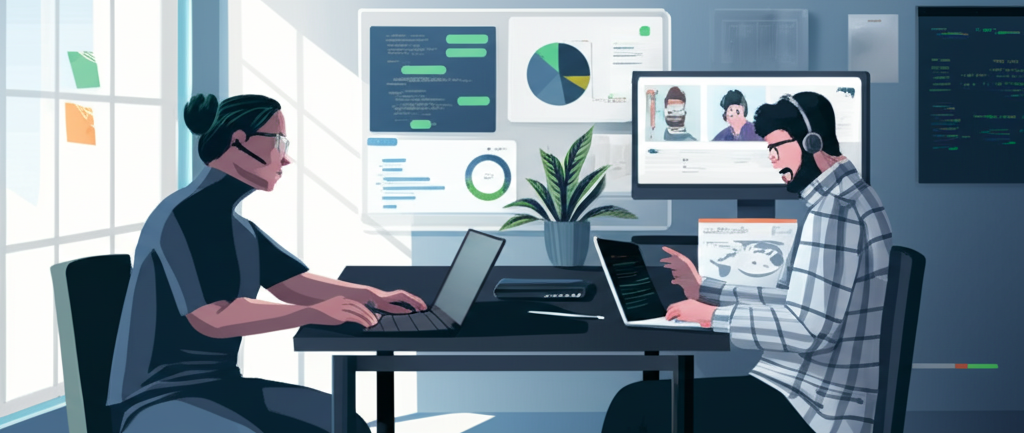
AI-native: an engineering team where agents do real work end-to-end. A cron job authors a blog post + opens a PR + auto-merges on green CI + posts to LinkedIn + syncs the lead capture to a Google Sheet. A senior engineer ships a feature in a 30-minute Claude Code session that would have been a two-week story. The PM cadence is daily, not bi-weekly. The QA pass is 80% automated. The contractor count goes to zero.
The proof point we point to most: Pineapples runs its entire marketing + analytics + lead-capture pipeline as an agentic cron. Every morning at 7am Detroit, a Claude-driven runner authors a fresh blog, publishes it through GitHub + Vercel, posts to the company LinkedIn, scrapes GA4, syncs newsletter signups to a sheet, and writes a daily report. Zero human in the loop. We're a services firm that practices what we deploy. That's the bar.
The cost-curve collapse
Three numbers worth keeping in mind when boards push for the "AI strategy":
- Engineering output per dollar is up ~5 to 10x for teams that have shifted to AI-native cadence. Not on synthetic benchmarks, on real production work. A cracked engineer with Claude Code ships in a week what a 5-person team used to ship in a month.
- Contractor + offshore staff-aug spend is collapsing. The mid-market shop running 30 contractors at $80/hour each is paying $4.8M/year for a delivery cadence that 4 senior owner-level operators with Claude Code now match.
- Time-to-decision in product is shrinking from quarters to weeks. When the design + spec + prototype loop runs at agent speed, the org's product velocity stops being gated by sprint cadence.
For a portfolio company doing $50 to $300M revenue, the implication is sharp: the 40-person engineering org should be a 6 to 10 person engineering org by end of 2026. That's not a layoff thesis. It's a different operating model.
Related reading on the cost-side: CFO IT Budget Playbook for Mid-Market and IT Cost Optimization for Mid-Market walk through how to structure the spend conversation when the curve is moving this fast.
The cracked-engineers + agents pattern
The teams shipping at the new pace look almost identical across companies:
- 3 to 6 senior owner-level engineers. Title is "Senior" or "Principal." Twenty years in if you stretch the band. Owner-mindset, no contractor mentality. Same person from kickoff through outcome.
- Each engineer runs Claude Code as their primary IDE. Not a side tool. The actual editor. The actual PR author. The actual test author.
- MCP connectors expose the company's internal systems to Claude. Salesforce, Snowflake, Postgres, internal APIs, the design system. Claude reads + writes against the real data, not a fake mock.
- Agentic workflows handle the recurring work. Cron-driven pipelines for deploys, releases, on-call rotation, lead capture, observability triage, even routine PR review.
- Each engineer carries 5 to 10 active surfaces simultaneously. Cross-codebase, cross-language, cross-domain. Context isolation between sessions, owner across.
We've written separately about AI Code Review Tools, AI Software Development for Mid-Market, and AI Integration Services. This piece is the umbrella over all of them.
What changes in the CFO conversation
Three structural shifts a CFO has to make in the budget cycle:
1. Engineering headcount is no longer the proxy for output. A 6-person team with $1.2M loaded cost is now shipping what a 30-person team with $4M loaded cost used to ship. The line item that grew (compute, tooling, platform) is small enough to not show up. The line item that shrank (engineering FTE) is the entire savings.
2. The "build vs. buy" calculus inverts on internal tools. Custom software used to be expensive enough that you bought a SaaS for everything. AI-native delivery makes custom software cheap enough that you build the things that matter. We covered this in detail in our Build vs Buy guide.
3. Contractor + staff-aug spend is the easiest line to retire. A 30-FTE contractor org delivered as an outcome is replaceable by a 4-operator owner-led team running AI-native. The board reads a 70% line-item cut. The CFO reads "delivery actually got faster." Both are true.
If your board is pressing for an AI line item next quarter, the path to credibility is showing a delivery-cost reduction tied to a tooling adoption, not a Copilot license count.
What changes in the COO / operations conversation
Operations leaders are asking a different question: which workflows can be replaced by an agent without breaking compliance or governance?
The honest answer in 2026: about 30 to 60% of operational workflows in a mid-market company. Not the strategic ones. Not the regulatory-sensitive ones. But the recurring ones, KPI reporting roll-ups, weekly board-pack assembly, vendor onboarding paperwork, quote-to-cash status checks, data quality audits, ticket triage and routing.
Examples we've shipped or seen ship in production:
- Weekly Monday-morning portco brief assembled automatically by an agent that reads each portco's source systems and produces a one-pager with deltas + flags.
- SAM.gov contract scraper that runs hourly, filters opportunities by NAICS + keyword profile, posts matches to Slack with a one-line synopsis. Replaces a 4-hour-per-week analyst task.
- Lead capture + enrichment that runs server-side on every form submit, pulls company data, scores fit, routes to the right owner, drops a row in a sheet, sends a personalized welcome email. Zero human in the loop.
Our pipeline does several of these for our own operations. The pattern is the same regardless of vertical. Related coverage in AI Workflow Automation for Mid-Market and Software Integration Services.
What changes in the CTO / VP Engineering conversation
This is the most uncomfortable conversation in 2026, because it's the one where the org chart actually changes.
The old org: 1 VP Eng → 3 EMs → 30 ICs → ring of contractors. Stand-up cadence, sprint cadence, quarterly OKRs. PM-driven backlog. Tickets land, tickets clear.
The new org: 1 owner-operator (sometimes the founder, sometimes a senior eng leader) → 4 to 6 cracked engineers, no managers in between. Each engineer carries an outcome end-to-end. Claude Code is the IDE. MCP connectors expose all relevant systems. Daily build-in-public update channel replaces standup. Ship-on-green replaces sprint demo. Outcomes-on-Slack replace quarterly business review.
For an engineering leader currently running the old model, the path forward is not a tools rollout. It's a delivery-cadence pilot: pick one team, one quarter, run the AI-native model end-to-end with senior operators only. Compare delivery throughput to a peer team running the old model. Decide structurally based on what the data shows.
We've written separately about how to think about this in Fractional CTO Services, CTO Assessment for PE Portfolios, and Interim CTO vs Full-Time CTO. The fractional / interim CTO model has gotten more compelling specifically because the AI-native operator is the kind of person who doesn't need to be full-time at any one company anymore.
The MCP layer specifically (why it matters)
If there is one piece of infrastructure under-discussed in mid-market AI strategy conversations, it is MCP, Model Context Protocol.
MCP is the standard that lets Claude (or any compatible model) actually read + write against a company's real systems. Before MCP, "AI for our company" meant prompting against generic data and hoping. After MCP, it means an agent that reads from your Salesforce, writes to your Postgres, queries your Snowflake, and posts to your Slack, with actual auth, actual access controls, and actual auditing.
In practice, this is what mid-market AI implementation looks like in 2026:
- Stand up an internal MCP server that wraps your top 5 systems of record.
- Connect Claude (Code or web) to that MCP server.
- Build the first 5 agentic workflows on top, the high-frequency, high-pain ones identified in the COO conversation above.
- Measure: hours saved, errors reduced, latency to decision.
- Expand based on what worked.
Step 1 is where most mid-market companies stall, because it requires senior engineering judgment about access scoping, connector design, and security boundary placement. That's where the cracked-engineers-as-a-service model fits cleanly: 1 to 2 senior operators stand up the MCP layer in 4 to 8 weeks, train the in-house team on operating it, then phase out.
The brand we're building toward
Pineapples.dev is leaning into being an owner-led, AI-native software firm for mid-market operators and PE portfolios. That's a specific bet. It means:
- We are NOT a staff-aug shop. No contractor roster. No bench-warmers.
- We ARE owner-level operators (26 years). Same person from kickoff to outcome.
- We RUN our own ops agentically in production, not as a demo. Our marketing pipeline runs every morning at 7am Detroit, no humans, in production for months.
- We ship into companies via pre-acquisition technology diligence (the 10-day fixed-fee), post-merger integration, fractional CTO, and AI-native delivery retainers.
If you're a CFO, COO, CEO, or PE operating partner reading this, the question isn't "can we afford an AI strategy." It's "can we afford to keep running a 2019-style engineering org while our peers retool." That window is closing fast.
Where to start
Three concrete first moves for a mid-market company starting now:
- Run a delivery-cadence pilot on one team for one quarter. Senior operators only. Claude Code as the IDE. MCP connectors to your top 3 systems. Measure throughput vs. a peer team.
- Identify the 5 highest-frequency workflows in operations. Score each on AI-native fit. Pick the top 2 and ship agentic workflows for them in 4 weeks.
- Inventory the contractor / staff-aug line. Anything not anchored to specific senior ownership is on the chopping block. Reallocate 30% of that budget to senior operators with AI-native delivery cadence.
If you're a PE operating partner reading this and want to understand what AI-native means in the context of a portfolio strategy, the related coverage on Pre-Acquisition Technology Assessment and Technology Due Diligence Checklist frames the diligence-side view. The post-acquisition value-creation view sits with this pillar.
Working with us on AI-native delivery
We engage three ways on AI-native:
- 30-day operating assessment. Senior operator on-site (or remote) for 30 days. Stack inventory, concentration risk, AI-native readiness, sequenced 12-month plan. Output is a 10-page memo + a roadmap. Fixed fee.
- MCP layer + first 5 agentic workflows. 4 to 8 week engagement. We stand up the internal MCP server, ship the top 5 workflows, train the in-house team. Outcome-priced.
- AI-native delivery retainer. 6 to 24 month engagement. 1 to 2 senior operators embedded, owner-led, ship features + agentic workflows continuously. Pricing keyed to outcome.
If you're working a specific situation, a portco that needs AI strategy in 90 days, an engineering org that needs to retool from 30 contractors to 6 cracked engineers, an MCP layer that needs to ship before the board meeting, book a call. Same operator from kickoff to outcome.
Frequently asked questions
What is AI-native software delivery and how is it different from using AI coding tools?
AI-native delivery is a fundamentally different operating model, not a productivity layer on top of a traditional engineering org. In an AI-native team, agents do real work end-to-end: authoring code, opening pull requests, running tests, and handling recurring operational tasks without a human in the loop. Using Copilot inside an unchanged org chart is not AI-native. The org chart, the contractor mix, the sprint cadence, and the QA process all have to change for the model to actually deliver its output advantage.
How many engineers does an AI-native mid-market team actually need?
According to the post, a portfolio company doing 50 to 300 million in revenue that shifts to AI-native delivery should be able to run a 6 to 10 person engineering org where a 40-person org operated before. The pattern described is 3 to 6 senior, owner-level engineers, each running Claude Code as their primary IDE and each carrying 5 to 10 active surfaces simultaneously. The contractor and offshore staff-aug headcount is intended to go to zero.
What is MCP and why does it matter for mid-market AI implementation?
MCP, the Model Context Protocol, is the infrastructure layer that lets an AI model like Claude read and write against a company's real systems, such as Salesforce, Postgres, Snowflake, or internal APIs, with actual authentication, access controls, and auditing. Without MCP, enterprise AI means prompting against generic data. With MCP, agents can act directly on the company's source-of-truth systems. The post identifies standing up an internal MCP server wrapping the top 5 systems of record as the first step in any mid-market AI implementation, and estimates that 1 to 2 senior operators can build that layer in 4 to 8 weeks.
How should a CFO think about engineering costs when evaluating an AI-native model?
The post identifies three shifts for the CFO budget conversation. First, engineering headcount is no longer the right proxy for output, since a 6-person team at roughly 1.2 million in loaded cost can now ship what a 30-person team at 4 million used to deliver. Second, the build-versus-buy calculus inverts on internal tooling because AI-native delivery makes custom software cheap enough to build the things that matter. Third, contractor and staff-aug spend is the easiest line to retire, with the 30-FTE contractor org replaceable by a 4-operator owner-led team running at AI-native cadence.
Working a live deal?
Book a 30-minute working session.
Same operator who runs the diligence engagements. No SDRs, no sales team. Bring the target, I'll bring the checklist.
Share this article
Anthony Wentzel
Founder, Pineapples
Anthony has spent 26 years operating mid-market software engineering teams. Pineapples runs an entirely agentic marketing + ops pipeline in production every day, and deploys the same patterns into PE portfolios and operator-led companies.