
How Much Does AI Automation Cost?

Anthony Wentzel
Founder, Pineapples
How Much Does AI Automation Cost?
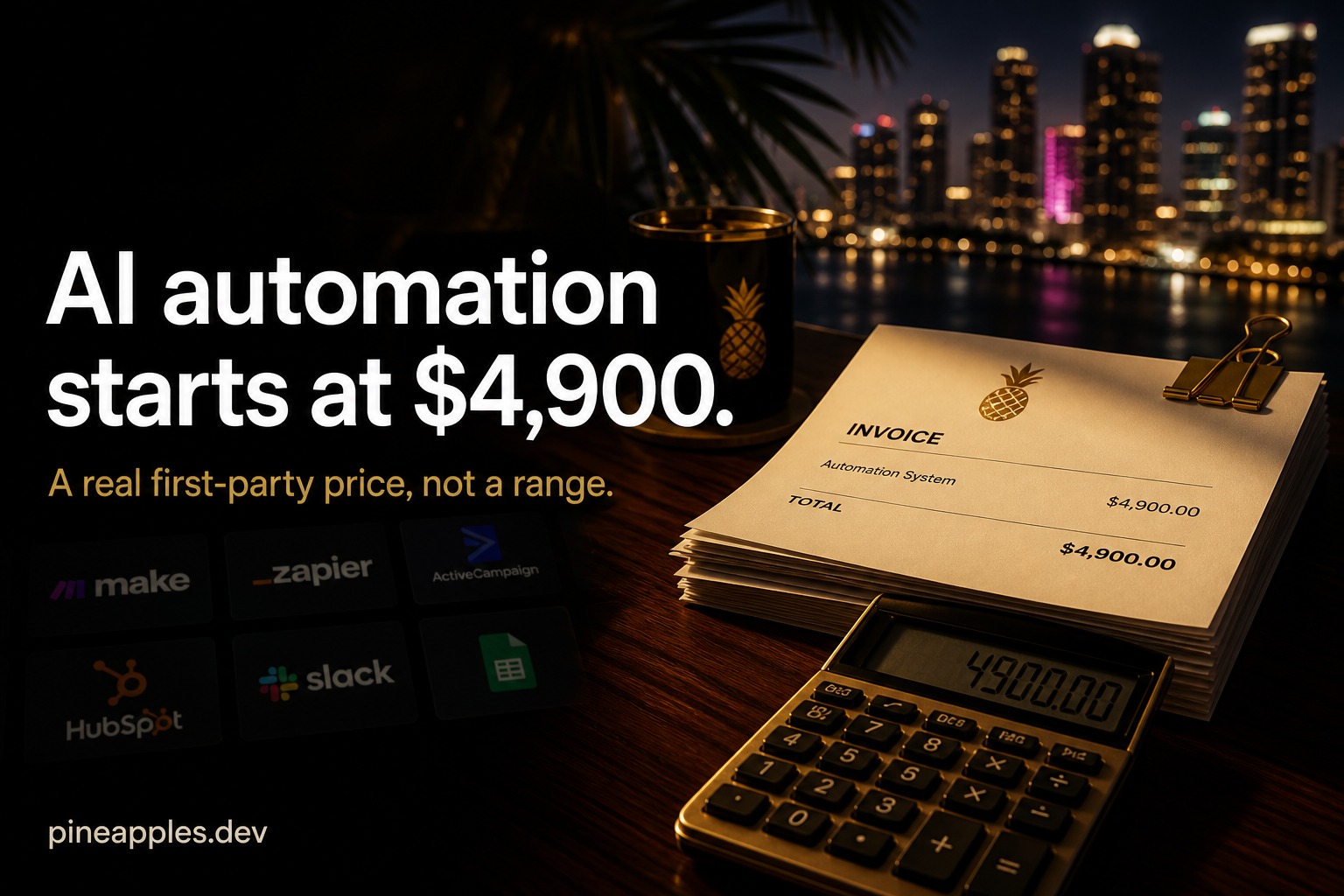
How much does AI automation cost? A first workflow is a fixed $4,900 Starter Workflow Pilot, live in 7 business days. Fuller Builds are $18K or $35K per workflow. Ops is $6,500 a month. DIY is your time plus tools. Those are published Pineapples prices. This page does not invent other ranges.
How much does AI automation cost for a small business?
Price one finished workflow. Do not price a vague "AI initiative."
Pineapples publishes first-party offers for that first step and the two rungs after it:
- DIY tools. Your time plus the subscriptions you already pay for. Cheap if you will maintain the connections. Expensive if you become the unofficial owner of a brittle zap.
- Starter Workflow Pilot. $4,900 fixed. 7 business days from kickoff. One production workflow.
- Agentic Workflow Build. $18K or $35K per workflow. 2-4 weeks depending on integrations. Scoping is included.
- Workflow Ops Retainer. $6,500 a month. Cancel any month. We operate and extend what already shipped.
Those four rungs are the whole AI automation pricing ladder on this page. If a vendor quotes a wide band with no deliverable and no date, they are not answering the same question.
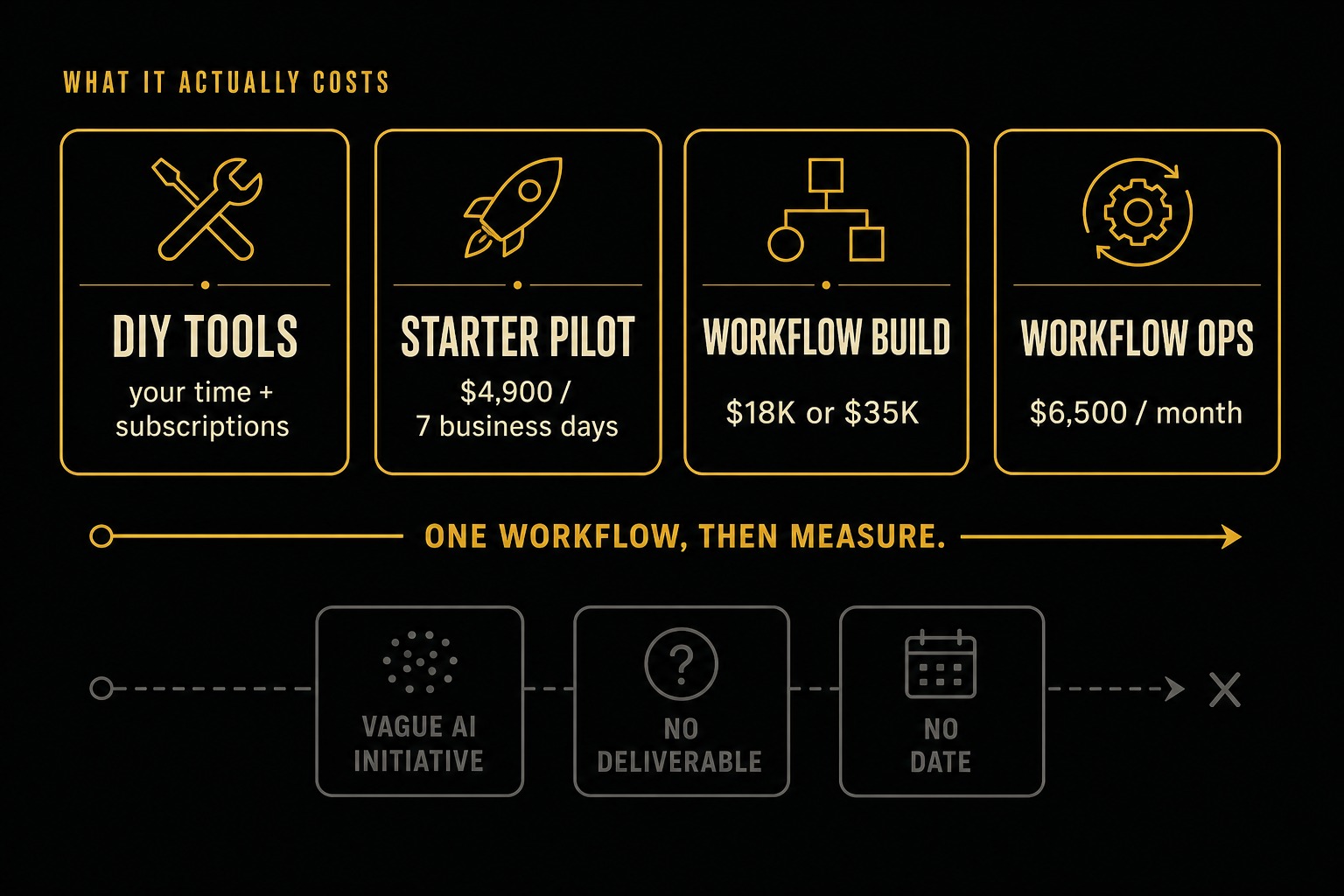
The diagram is the same ladder: DIY (your time plus subscriptions), Pilot at $4,900 in 7 business days, Build at $18K or $35K, Ops at $6,500 a month. One workflow, then measure. A vague initiative with no deliverable and no date is the failed path.
If you want an hours-and-dollars sketch from your own volume and wage rates before you buy, use the automation ROI calculator. It is a model, not a promise.
A sibling draft covers what a small business should automate first. This page is the price page. If you have not named the process yet, start from the ladder above and describe the weekly task in chat.
What is included in a $4,900 pilot?
The Pilot is one process shipped as proof, not a roadmap deck.
From the Starter Workflow Pilot offer:
- a 45-minute kickoff to pick the one process
- one production workflow with a single integration (email, sheets, CRM, or Slack)
- human-in-the-loop approval where it matters
- a Loom walkthrough and a simple runbook
- 100% of the fee credited toward a Build within 30 days
Timeline is 7 business days from kickoff. The kickoff names the process. The build connects it to a system you already use. The handoff is a Loom and a runbook someone on your team can explain without calling the builder.
That is enough to decide whether a larger Build is worth it. If you keep going inside 30 days, the $4,900 credits in full toward that Build.
If you already know the workflow and want a fuller production build, the next first-party step is an Agentic Workflow Build at $18K or $35K per workflow. Typical timeline is 2-4 weeks. Scoping is included, so there is no separate discovery step to buy first. The Build ships integrations, approvals where needed, monitoring, a runbook, and 30 days of post-launch support.
After something is live, Workflow Ops is $6,500 a month if you want the agents operated and extended instead of hiring a full-time automation lead. Cancel any month.
Why do quotes range so widely?
Most AI automation agency cost quotes are not pricing the same product.
One shop is selling a strategy month. Another is selling a live workflow. A third is selling a pile of connector recipes with no owner after the invoice. The number moves when any of these are undefined:
- Scope. "Automate operations" is not a price. One weekly process is a price.
- Deliverable. A slide deck is cheaper than a workflow that runs in your inbox on Monday.
- Integrations. One mailbox, sheet, CRM, or Slack channel is a Pilot. Five systems is a program.
- Approvals. A path with no human catch looks cheaper until a bad output reaches a customer.
- Who owns it next month. If you will not maintain it, you need a named ops price, not a hope.
- Discovery as a separate buy. Some quotes hide a second invoice before anyone builds.
Ask the vendor to name one process, one integration, one date you can watch it run, and what happens to the fee if you later want a fuller build. If they cannot, the range is doing the work that a deliverable should do.
The same "one workflow, then measure" idea shows up in our AI workflow automation guide, written there for larger financial-services teams. The owner version is narrower. You are not buying a 90-day program. You are buying one path you can see.
DIY tools vs an agency?
This is a cost and ownership question, not a brand question.
Stay on DIY tools when:
- the path is linear (if this, then that)
- you or someone on the team will maintain the connections
- a missed step is easy to see and reverse
- you are testing whether the process is even worth keeping
Connector tools and a careful chat habit can cover a lot of copy-paste. The limit shows up when the workflow needs memory, an approval gate, or a clean handoff when you are not in the room.
Use a scoped agency or Pilot when:
- you need the workflow live in your real stack, not in a demo account
- the first integration is email, sheets, CRM, or Slack, and you want it done in days
- someone besides you has to run it next month
- you want a runbook, not a pile of undocumented automations
A hybrid is normal. Keep the simple routing in a tool you already pay for. Put the messy judgment, the approval, and the customer-facing output in a workflow someone designed on purpose.
If the choice you are actually making is more hours from a virtual assistant versus a workflow, start with hiring a VA vs AI automation. A person is still the right first move when the process is messy and changing. A workflow is the right first move when the same path already repeats and you can write the steps down.
The agency-vs-DIY question is not "which brand of AI is smarter." It is "who owns the failure when the workflow is wrong on a Tuesday."
How do I know the spend is working?
Decide the scoreboard before you spend. Otherwise "it works" means "it did not crash this morning."
Pick 3 numbers you can already count by hand:
- Cycle time. Intake to done. Invoice sent, ticket closed, follow-up delivered, report in the inbox.
- Manual touches. How many times a person has to copy, paste, or chase.
- Misses. Late items, dropped leads, tickets that aged out, reports that needed a rewrite.
Write the current number down. Then write the number you would accept after one week of live use. If you cannot name both, you are not ready to buy a workflow. You are ready to watch the process for a week.
After it is live, keep a person on the exceptions. The first workflow should make the happy path boring and make the weird cases louder, not quieter. If exceptions disappear into a black box, turn the automation off until you can see them again.
When the first path is stable, the next spend is easier to choose. You already know how you pick, how you measure, and how you hand off. The first project is still just one process.
If you want the Pilot shape, start in chat. Describe the weekly process that bothers you most. The priced next step, when you want one, is on the offers strip: Starter Workflow Pilot, $4,900, 7 business days.
Frequently asked questions
How much does AI automation cost for a small business?
Pineapples publishes four rungs. A first workflow is a $4,900 Starter Workflow Pilot, fixed, in 7 business days. A fuller Agentic Workflow Build is $18K or $35K per workflow, typically 2-4 weeks, with scoping included. Workflow Ops is $6,500 a month, cancel any month. DIY is your time plus the tools you already pay for. Those are the only dollar figures this page uses.
What is included in a $4,900 Starter Workflow Pilot?
The Pilot is one production workflow, not a discovery deck. You get a 45-minute kickoff to pick the one process, a single integration (email, sheets, CRM, or Slack), human-in-the-loop approval where it matters, a Loom walkthrough, and a simple runbook. The fee credits 100% toward a Build within 30 days.
Why do AI automation quotes range so widely?
Most quotes are not pricing the same product. One vendor is selling a vague initiative. Another is selling a live workflow. Discovery billed as a separate project, extra integrations, and who owns the workflow after launch all move the number. Ask for one process, one integration, one date you can watch it run, and a named monthly ops price if you will not own it yourself.
Should I use DIY tools or an AI automation agency?
DIY tools are enough when the path is linear, you will maintain the connections, and a missed step is easy to fix by hand. A scoped agency or Pilot is the better first spend when you need a production workflow in your real stack, with an approval gate and a handoff someone besides you can run. The question is who owns the failure on a Tuesday, not which brand of AI is smarter.
How do I know the AI automation spend is working?
Write the current cycle time, manual touches, and misses before kickoff, then write the numbers you would accept after one week live. Keep a person on exceptions. The first workflow should make the happy path boring and the weird cases louder. Use the automation ROI calculator as an hours-and-dollars sketch from your own volume, not as a promise.
Working a live deal?
Book a 30-minute working session.
Same operator who runs the diligence engagements. No SDRs, no sales team. Bring the target, I'll bring the checklist.
Share this article
Anthony Wentzel
Founder, Pineapples
Anthony Wentzel has spent 26 years helping mid-market operators turn technology friction into concrete decisions about systems, ownership, cost, and speed.