
Technology Due Diligence Consulting for PE and Mid-Market Buyers

Anthony Wentzel
Founder, Pineapples
Technology Due Diligence Consulting for PE and Mid-Market Buyers
PE and mid-market buyers hire technology due diligence consulting to turn code, architecture, people-risk, and integration cost into line items in the deal model. Pineapples prices Technology Diligence at $25K or $60K, 10 business days from data-room access. Not a 200-slide deck.
What is technology due diligence consulting?
Technology due diligence consulting is the hired version of technology due diligence. A PE operating partner, family office, or mid-market acquirer brings in an outside operator before close. The consultant reads the code, the architecture, the people who actually run it, and the cost to integrate it. Then those findings become numbers the investment committee can use.
That is private equity technology due diligence and M&A technology due diligence as a service, not as a weekend spreadsheet. The buyer is not paying for a longer inventory of languages and cloud accounts. The buyer is paying for a priced answer to three questions:
- What in this stack changes the purchase price?
- What in this team changes the first-year plan?
- What in this integration changes the reserve?
Technology due diligence consultants earn the fee when the readout can sit next to finance and legal, not when the slide count looks thorough. A technology due diligence consultant who cannot name a line item has produced IT commentary. Technology due diligence services that stop at "medium risk" leave the model untouched.
Pineapples runs this as owner-led Technology Diligence. Same operator from data-room access to the readout. The published offer lives on the PE engagements page.
What does a PE tech DD actually cover?
A PE tech DD that moves the model covers more than a stack list and a SOC 2 checkbox. Pineapples publishes Technology Diligence as a seven-section assessment. The sections are:
- Stack inventory. What is deployed, where it runs, and which architectural choices will or will not hold the next phase.
- Leadership-execution capability. Whether the people who built the product can execute the integration the thesis assumes.
- Knowledge-concentration risk. Which systems sit with one or two people, and what breaks if they leave.
- Integration surface area. How hard it is to connect the target to the platform, not how tidy the diagram looks.
- Technical debt that actually blocks the plan. Debt that changes the roadmap, not a generic "needs refactoring" score.
- Vendor and supply-chain risk. Concentration, renewals, and dependencies the deal team will inherit.
- Deal-thesis alignment. Whether the technology in the room matches the story in the memo.
The published deliverables on that engagement are:
- AI-augmented codebase and architecture audit
- Knowledge-concentration and single-point-of-failure map
- Deal-thesis alignment review
- Re-baselined integration plan and remediation budget
- Reference calls with 3 prior PE clients
That is the coverage. Findings are written as deal-model line items. If a finding cannot be priced, held back, or scheduled, it is not finished.
The technology due diligence checklist for mid-market M&A is the self-serve question list. This page is the commercial engagement that runs the work in 10 business days.
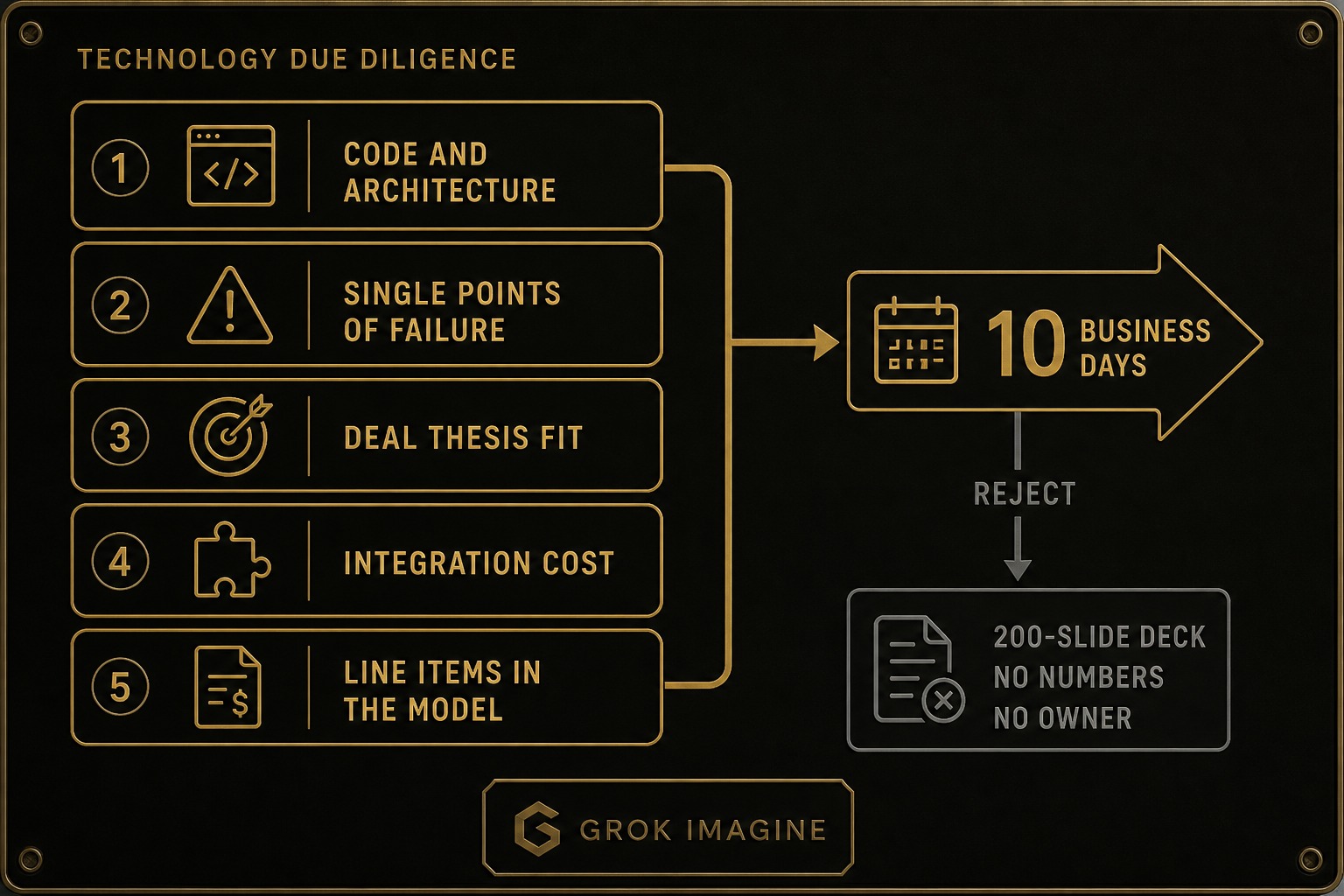
The diagram is the same offer: five inputs (code and architecture, single points of failure, deal thesis fit, integration cost, line items in the model) into a 10-business-day readout. The rejected path is a 200-slide deck with no numbers and no owner.
How much does it cost?
Pineapples prices Technology Diligence at $25K or $60K per engagement. The clock is 10 business days from data-room access. Those are the only diligence fees on this page.
What you are buying:
- A seven-section assessment, not an open-ended hourly review
- Findings written so finance can put them in the model
- A re-baselined integration plan and a remediation budget
- Reference calls with 3 prior PE clients
What you are not buying:
- A 200-slide appendix
- A junior-staffed survey that restates the data room
- A separate discovery invoice before anyone reads the code
If the deal is heading to IC in the next 2-4 weeks, book a PE scope call. If you want the full PE menu, including Fractional CTO at $15K or $35K a month and AI-Native Build from $4,500 per 2-week sprint, it is on AI-native SaaS engagements.
After close, a portco that wants one production workflow as proof can use the Starter Workflow Pilot. That is a later wedge. It is not the hero offer for the deal room.
How is this different from a generic IT checklist?
A generic IT checklist asks whether tools exist. It scores ticketing, backups, MFA, and a vendor list. Useful. Incomplete.
Technology due diligence consulting asks what those answers do to year-one cash, synergy timing, and the people who have to ship the plan. The difference shows up in the output:
| Generic IT checklist | Diligence consulting | |---|---| | Inventory of systems | Priced gaps in the systems that carry revenue | | "Documentation is light" | Knowledge concentration mapped to a named failure | | Security questionnaire | Controls that change renewals, liability, or the reserve | | "Integration looks feasible" | A re-baselined integration plan and a remediation budget | | Risk adjectives | Line items the IC can accept, reprice, or hold back |
If you only need the questions, keep the M&A technology due diligence checklist. If the deal needs an operator who will turn the answers into a model the committee can vote on, that is the consulting buy.
The same gap shows up after close. A checklist that never became a budget becomes a post-merger technology integration surprise. The cheaper time to price integration is before the press release.
When should a family office or operating partner buy it?
Buy technology due diligence consulting when the next decision is a price, a holdback, or a no, and technology can change that decision. The published offer is built for:
- Deals heading to IC in the next 2-4 weeks
- Buy-and-build platforms with integration risk
- A second read after a commodity report
A family office should buy it when the operating partner (or the family member wearing that hat) cannot sit in the data room for 10 business days and still own the model. Mid-market strategic buyers should buy it when the thesis depends on combining systems, not only on combining P&Ls.
Do not buy it as a vague AI pitch. Do not buy it to decorate a binder. Do not buy it if there is no data-room date. The clock starts at access.
If the target is already closed and the problem is leadership week to week, that is the Fractional CTO offer, not diligence. If the problem is shipping integration or product after the model is set, that is an AI-Native Build. Both sit on the same PE engagements page.
If you have a live deal and want the 10-day readout, scope it on Calendly. Same operator. Findings as line items.
Related reading
Frequently asked questions
What is technology due diligence consulting?
Technology due diligence consulting is a pre-close assessment that a PE firm, family office, or mid-market buyer hires so code, architecture, people-risk, and integration cost show up as line items in the deal model. The job is not a stack inventory for its own sake. It is a priced read on whether the technology can support the thesis before IC.
What does a PE tech DD actually cover?
Pineapples Technology Diligence is a seven-section assessment. It covers stack inventory, leadership-execution capability, knowledge-concentration risk, integration surface area, technical debt that actually blocks the plan, vendor and supply-chain risk, and deal-thesis alignment. The published deliverables include an AI-augmented codebase and architecture audit, a single-point-of-failure map, a re-baselined integration plan and remediation budget, and reference calls with 3 prior PE clients.
How much does it cost?
Pineapples prices Technology Diligence at $25K or $60K per engagement. The timeline is 10 business days from data-room access. Those are the only diligence fees on this page. Book a PE scope call on Calendly or see the PE engagements on the AI-native SaaS page.
How is this different from a generic IT checklist?
A generic IT checklist scores tools, tickets, and controls. Technology due diligence consulting prices what those findings do to the model. The output is a remediation budget and an integration plan the operating partner can carry into IC, not a 200-slide deck with no owner. Use the live M&A checklist when you want the self-serve questions. Hire the consulting engagement when the deal needs numbers.
When should a family office or operating partner buy it?
Buy it when a deal is heading to IC in the next 2-4 weeks, when the platform is a buy-and-build with real integration risk, or when you already have a commodity report and want a second read. Do not buy it as a vague AI strategy. After close, a portco that wants one production workflow as proof can use the Starter Workflow Pilot. That is a later wedge, not the deal-room CTA.
Working a live deal?
Book a 30-minute working session.
Same operator who runs the diligence engagements. No SDRs, no sales team. Bring the target, I'll bring the checklist.
Share this article
Anthony Wentzel
Founder, Pineapples
Anthony Wentzel has spent 26 years helping mid-market and PE operators turn technology risk into decisions that fit a deal model. He is the founder of Pineapples.