
React Native vs Flutter: Pick the Stack You Can Staff

Anthony Wentzel
Founder, Pineapples

React Native vs Flutter: Pick the Stack You Can Staff
React Native vs Flutter is a staffing and handover decision. For most mid-market teams that already ship web in React or TypeScript, React Native with Expo is the default. Flutter is the better call when Dart talent is already on the roster, the product is a custom-pixel UI, and you do not need the same people owning web and mobile. Do not pick from a widget bake-off.
Pineapples is an AI-native engineering partner that also ships React Native and Expo. The published build seat is AI-Native Build from $4,500 per 2-week sprint.
Should a mid-market team choose React Native or Flutter?
Start with the team you can hire and keep. Then look at the product.
React Native (almost always with Expo in 2026) is the default when:
- The website already runs on React or TypeScript
- One squad should own web and mobile
- You want store releases plus over-the-air updates for JS changes
- Most screens are business workflows, not a custom-drawn brand world
- You will still drop into a native module when camera, maps, Bluetooth, or a hot path needs it
That is the same reason mid-market buyers keep asking why use React Native. Shared language with the web team. One product behavior on iOS and Android. A path back to native when the shared layer is not enough.
Flutter is on the table when:
- Dart engineers are already hired, or you have a credible plan to keep them
- The product is a custom-pixel interface that should look identical on every device
- Mobile can live as its own hiring lane, separate from the web stack
- You are not counting on the React team to become the Flutter team after launch
If you are still deciding whether a mobile app development company should even be in the room, lock the stack against the roster first. A partner who starts with a framework preference, and only then asks who will own the repo, is selling a bench. Not a handover.
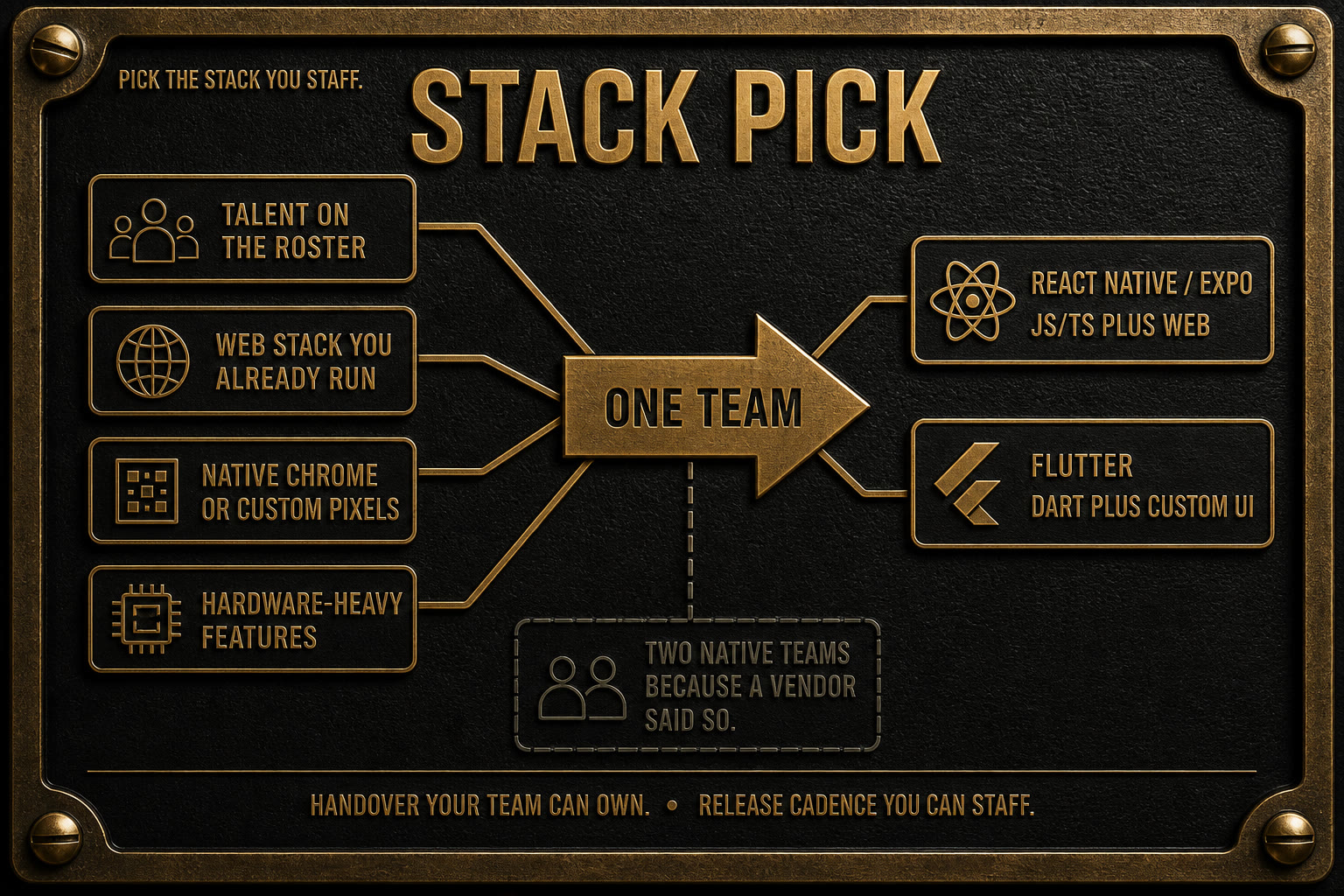
The diagram is the same offer. Four inputs (talent, web stack, native chrome vs custom pixels, hardware-heavy features) into one team. Outputs are React Native with Expo, or Flutter. The rejected path is two native teams because a vendor said so.
When is Flutter the better call?
Flutter wins when the product is the interface.
If the app is a designed environment (a consumer brand world, a dense data canvas, a UI that should ignore iOS and Android chrome), Flutter's self-drawn widgets are the point. You are not borrowing native controls. You are shipping a picture you control.
Flutter also wins when Dart is already a real bench. A portco that has shipped Flutter for two years, with people who can cut a release, should not rewrite into React Native because a new vendor likes JavaScript. Rewrites are not strategy. They are a second product.
Leave Flutter off the shortlist when the argument is any of these:
- A demo that looked smoother than last year's React Native sample
- A hiring market slide with no named people you can actually recruit
- "The web team will learn Dart"
- A hope that two native teams will be simpler than one cross-platform repo
Native modules exist in both worlds. Hardware-heavy work (background location, proprietary SDKs, tight camera pipelines) will still need platform engineers. Flutter does not remove that. React Native does not remove that. Budget the native slice either way.
What does this pick cost you after launch?
The invoice you remember is the build. The cost that stays is who can ship the next release.
After launch you pay for three things:
- Hiring. React Native draws from the same TypeScript pool as the website. Flutter draws from a Dart pool. If you cannot name three people you would hire next, you picked a language, not a team.
- Release cadence. Expo makes store builds and over-the-air JS updates a weekly habit for a small squad. Flutter teams can be just as fast. They still need people who live in that toolchain. A stack nobody on staff can release is a stall, not a platform.
- Handover. The useful test is simple. If the vendor leaves in 90 days, can your internal team cut a hotfix? If the answer is "we would hire a new Flutter contractor," you did not buy a product. You rented a bench.
Two native teams (Swift plus Kotlin) double those costs. That is the path the diagram rejects. It shows up when a vendor says "native is safer" and cannot show a release train you can staff. Cross-platform is the mid-market default because one codebase is cheaper to keep correct. The React Native development company guide is the partner-selection version of that test.
Do not invent a winner from frame-rate folklore. A slow React Native list and a slow Flutter list are both a performance problem. Fix the list. Do not switch the framework to avoid the work.
How should a PE or family-office operator underwrite the choice?
Underwrite React Native vs Flutter the same way you underwrite any inherited system. Who can ship. What breaks if they leave. What the next 12 months of releases actually cost.
Ask the portco or the target five questions:
- What language does the web team already ship in?
- Who cut the last iOS and Android store release, and are they still here?
- How much of the app is shared code vs platform-specific modules?
- What happens to a hotfix if the current vendor is gone next quarter?
- Is the UI a set of business screens, or a custom-drawn product?
If the answers point at a React or TypeScript bench, React Native is the cheaper handover. If the answers point at a healthy Flutter repo and a Dart bench, keep Flutter. If nobody can answer, you do not have a stack decision. You have a diligence problem.
That read belongs next to AI-native software delivery. The operating model is a small owner-led team, not a 40-person mobile org with a contractor layer. The stack has to match the people who will sit in that model. A framework that needs a parallel hiring lane fights the cost curve you just told the board you were buying.
Family-office and PE operators should treat a mobile rewrite as a priced line, not a taste preference. If the thesis does not need a new UI toolkit, do not pay for one.
Who should build it?
Hire the operator who will pick from the roster, then ship.
A credible partner does four things before anyone opens Xcode or Android Studio:
- Names the stack against talent you already have
- Writes the v1 as one core workflow, not a feature catalog
- Plans Expo (or the Flutter equivalent) for release, QA, and store discipline
- Leaves a handover your internal team can run
Pineapples ships that as React Native and Expo on the React Native + Expo service. Same operator from the working session to the first store release. The published PE and mid-market menu is on the PE engagements page:
- AI-Native Build from $4,500 per 2-week sprint when the work is real software, including web plus mobile
- Fractional CTO at $15K or $35K a month when the company needs the same person to own the stack call week to week
- Technology Diligence at $25K or $60K when a live file includes a mobile repo you have to price before IC
Those are the live fees. This page does not invent others.
The $4,900 Starter Pilot is a later wedge if you only want one proof workflow after the operating model is set. It is not the hero offer for a mid-market mobile stack.
Do not hire a studio that only sells Flutter because that is the bench they staffed. Do not hire a studio that only sells React Native and cannot say when Flutter would be right. Do not hire anyone who will not put a named owner on the first release.
If you want the stack picked against the team you have, start in chat or book a PE working session. Same operator. React Native and Expo when that is the honest default.
Related reading
Frequently asked questions
Should a mid-market team choose React Native or Flutter?
Default to React Native with Expo when the company already ships web in React or TypeScript and wants one team that can own web and mobile. Choose Flutter when Dart talent is already on the roster, the product is a custom-pixel interface, and you do not need the same people owning the website. The stack pick is a staffing and handover decision, not a widget bake-off.
When is Flutter the better call than React Native?
Flutter is the better call when you already have Dart engineers you can keep, the product lives or dies on a custom-drawn UI, and you are willing to run mobile as its own hiring lane. It is the wrong call when the only argument is a vendor demo, a framework popularity chart, or a hope that the web team will pick up Dart after launch.
What does a React Native vs Flutter pick cost you after launch?
After launch you pay in hiring, release cadence, and who can own a hotfix. React Native with Expo usually lets a TypeScript team ship iOS and Android, push over-the-air updates for JS changes, and drop into native modules when a feature needs them. Flutter usually needs a Dart bench and a separate path from the web stack. Two native teams cost you twice the hiring and twice the release coordination.
How should a PE or family-office operator underwrite React Native vs Flutter?
Underwrite the stack by asking who on the inherited team can ship a store release next quarter, and what happens if the vendor leaves. If the portco already runs React or TypeScript, React Native is the cheaper handover. If the product is a Flutter app with a real Dart bench, keep Flutter. Do not score the pick on a benchmark slide.
Who should build a React Native or Flutter app for a mid-market team?
Hire a partner who will pick the stack from the roster you have, ship with Expo when React Native is the call, and leave a handover your internal team can run. Pineapples is an AI-native engineering partner that ships React Native and Expo. The published build seat is AI-Native Build from $4,500 per 2-week sprint. The $4,900 Starter Pilot is a later wedge, not the mobile-stack conversation.
Working a live deal?
Book a 30-minute working session.
Same operator who runs the diligence engagements. No SDRs, no sales team. Bring the target, I'll bring the checklist.
Share this article
Anthony Wentzel
Founder, Pineapples
Anthony Wentzel has spent 26 years helping mid-market, PE, and family-office operators turn stack decisions into software they can staff and own. He is the founder of Pineapples.