
AI-Native Retainers vs. Project Shops: What PE and Mid-Market Actually Buy
Anthony Wentzel
Founder, Pineapples
AI-Native Retainers vs. Project Shops: What PE and Mid-Market Actually Buy
PE and mid-market buyers do not buy a stack of statements of work. They buy an operator who keeps institutional knowledge across diligence, build, and stabilize. A project shop resets that context every SOW. A retainer compounds it. The $4,900 SMB pilot is a wedge for proof. The identity is operator-grade AI-native delivery.
I write this page for the operating partner, the mid-market CEO, and the family-office principal who already hired a shop, or is about to, and still cannot name the person who remembers why the last integration was shaped that way.
The software development retainer guide is the buyer mechanics. This page is the PE and mid-market thesis. Do not treat those as the same document.
What do PE and mid-market buyers actually buy?
The phrase sounds like a vendor category. It is a test.
I do not start with a rate card, a staffed bench, or a wall of logos. I start with the object that still has to work on Monday after the invoice.
- Who still knows the file when the SOW ends
- Whether diligence findings can be built by the same person who wrote them
- Whether the build has an owner after the demo
- Whether stabilize is a retainer, or a warranty clause nobody will pick up
If the shop cannot walk those, you bought a project. You did not buy an operator.
AI-native software delivery is the operating-model read. This page is the commercial shape that model has to take for PE, mid-market, and family office. Same problem. Different purchase.
A software development partner page will still ask how to score a vendor. Fine work for a bake-off. It is not the retainer-versus-shop question. Scoring a shop that will reset in 90 days is how you buy activity and call it a plan.
Why do retainers compound knowledge while project shops reset it?
A project shop is paid to finish a box. The box has a start date, a stop date, and a roster that exists for the length of the invoice.
That would be fine if software were a warehouse job. It is not. The next change depends on why the last one was shaped that way. The join key. The exception path. The person at the portco who still holds the admin login. The finding that never made it into the model.
A retainer keeps that context in one head, then writes it into objects a second person can open. The repo. The runbook. The weekly file. The decision log. Knowledge compounds because the same operator is still on the file when the next question shows up.
A project shop does the opposite. New SOW. New discovery. New deck that restates what the last team already knew. The code is still there. The memory is not. You pay again to relearn your own system.
I have sat in rooms where the second SOW cost more than the first because the first team left and nobody could explain the integration they just shipped. That is not a staffing inconvenience. That is the product you bought.
Staff augmentation versus managed teams is the capacity-versus-ownership cousin. This page is narrower. Even a managed team resets if you buy it as a project. Continuity is the retainer. Hours are the shop.
Is the $4,900 SMB pilot the product, or only a proof wedge?
It is a wedge. It is not the identity.
The $4,900 SMB pilot exists so a buyer can see one production workflow before they argue about a longer seat. One process. A short clock. Proof that agents can do real work in the stack you already have.
That is useful. It is not what PE, mid-market, and family-office ICPs are buying when they say they want AI-native delivery.
The identity is an operator who will stay on the file. Diligence that becomes a build. A build that becomes a system someone can run. That seat is a retainer, not a pilot SKU with a different label.
I do not lead a live PE file with a pilot price. I lead with the motion. If a later proof workflow is the honest next step after the operating model is set, the $4,900 wedge is there. If the file already needs an owner week to week, a pilot is a delay dressed up as caution.
Do not confuse a handshake with the product. The product is operator-grade AI-native delivery.
Why is diligence plus build plus stabilize one motion?
Because the buyer who splits them inherits three vendors and no owner.
Diligence without build is a PDF. Technical due diligence still matters on a live file. A finding that nobody will implement is a slide you cannot operate.
Build without diligence is a shop guessing. They will rediscover the concentration risk, the shared database, and the person who still holds the keys. You already paid for that read. You are paying again because the builder was not in the room.
Build without stabilize is a demo with a warranty clause. The first exception after go-live has no named owner. The shop has moved to the next SOW. Your sitting team has a system they did not design and cannot change.
PE and family-office ICPs feel this as one problem. The deal needs a priced read. The portco needs the change shipped. The office needs the system to stay true after the operator who shipped it is supposed to still be there. That is Fractional CTO territory when the hole is week-to-week technology leadership. It is the same motion when the hole is AI-native delivery. Do not buy those as three projects.
One operator. One file. Diligence writes the build. The build has a stabilize path. The memory stays.
The published PE menu lives on the engagements page. This page does not invent a rate card.
How do I tell a project shop from an AI-native retainer?
I do not ask for a capability deck. I ask what happens to the file when the invoice ends.
Roster. Same person from the data room to the first production week, or a bench that rotates by SOW.
Memory. Objects a second person can open, or a Slack channel that dies with the project.
Motion. Diligence, build, and stabilize under one owner, or three statements of work with three account managers.
Proof. A workflow that already runs in your stack, or a slide that promises agents later.
Identity. Operator-grade delivery on retainer, or a shop that will re-pitch you in a quarter.
If the answers point at a rotating bench, you are buying a project shop. Call it that. A project rescue later is more expensive than naming the model now.
I run this as owner-led work. Same operator from the working session to the system that still runs. Not a deck shop. Not a body shop that vanishes when the SOW closes.
If you have a live file, or a portco that is about to buy another project, start in chat. Bring the last SOW and the person who still remembers the stack. I will sit with both.
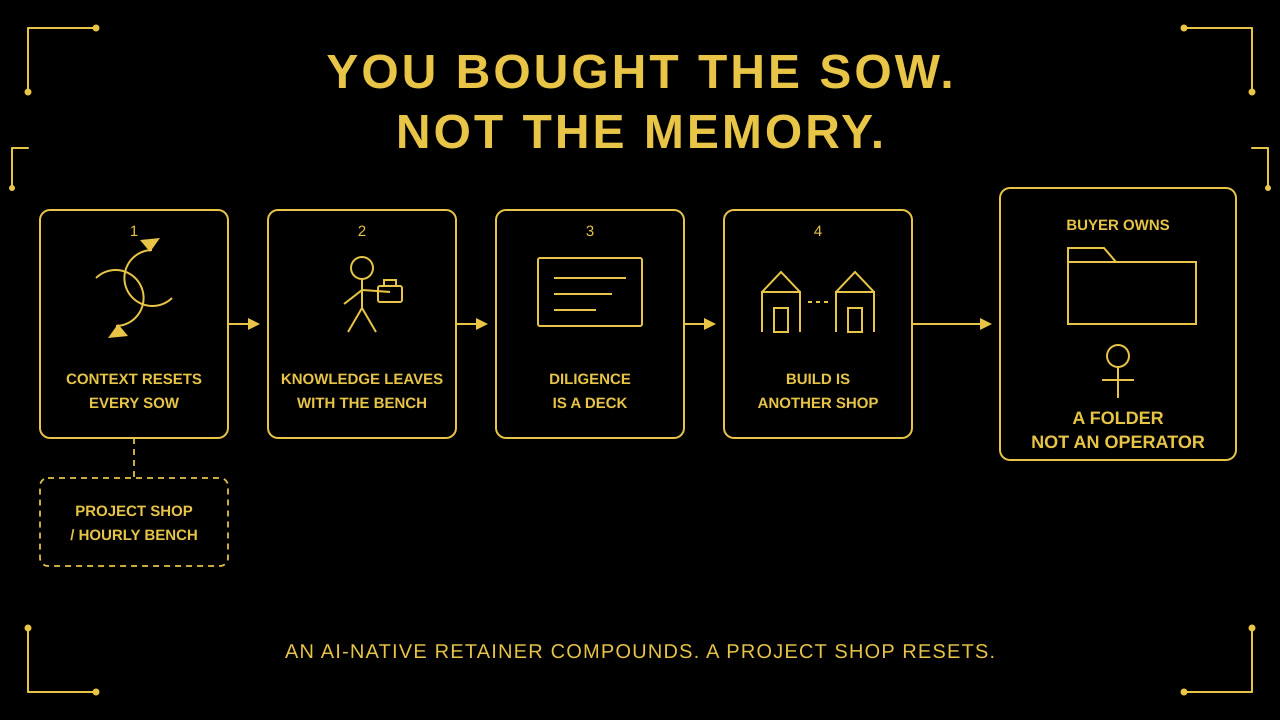
The diagram is the finding. Context that resets. Knowledge that walks. Diligence that stays a deck. Build that is another shop. That chain is a folder you cannot operate. The project shop is the side path.
What do I take into the next operating meeting?
I take the objects that decide whether you have an operator. I stop.
Who still knows the file. Which finding became a build. Which build has a stabilize owner. Whether the last SOW left memory, or only a repo.
If those are clean, the vendor matrix can wait. If they are not clean, the vendor matrix does not matter yet.
I do not ask a project shop how they feel about the next phase. I ask whether a second person can pick up the file without a kickoff. Either they can or they cannot. If they cannot, keep the cash. The SOW will still be in the folder.
Related reading
Frequently asked questions
What is an AI-native retainer?
An AI-native retainer is an ongoing operator seat that keeps institutional knowledge across diligence, build, and stabilize. Same person week to week. The buy is continuity on the live file, not a rented bench for the length of one statement of work.
How is an AI-native retainer different from a project shop?
A project shop sells a scoped SOW, staffs a bench, and resets context when the invoice ends. An AI-native retainer compounds what the operator already learned about the stack, the people, and the thesis. PE and mid-market buyers are buying that memory, not another kickoff deck.
Why do project shops reset context every SOW?
Each new statement of work usually brings a new roster, a new discovery pass, and a new write-up of systems the last team already touched. The repo is still there. The reason a join key was shaped that way is not. That reset is the product when you buy projects. It is the failure mode when you needed an operator.
Is the $4,900 SMB pilot what PE and mid-market should buy?
No. The $4,900 SMB pilot is a wedge for proof on one workflow. It is not the identity of the firm and it is not the PE or family-office buy. The identity is operator-grade AI-native delivery on retainer, where diligence, build, and stabilize stay one motion.
Why is diligence plus build plus stabilize one motion?
A finding that cannot be built, and a build that nobody stabilizes, is three vendors and no owner. PE, mid-market, and family-office ICPs need the same operator to read the file, ship the change, and stay on the system. Split those and you buy a folder.
Working a live deal?
Book a 30-minute working session.
Same operator who runs the diligence engagements. No SDRs, no sales team. Bring the target, I'll bring the checklist.
Share this article
Anthony Wentzel
Founder, Pineapples
Anthony Wentzel has spent 26 years helping mid-market, PE, and family-office operators turn technology risk into decisions they can own. He is the founder of Pineapples.