
Private Equity Software for Lean Teams: Automating Diligence and Portfolio Monitoring
Anthony Wentzel
Founder, Pineapples
Private Equity Software for Lean Teams: Automating Diligence and Portfolio Monitoring
Private equity software for a lean team is the system that writes diligence into the deal model and turns portfolio monitoring into a weekly operating file. I look at whether the data room updates the model, and whether portco status is more than a slide. A deal CRM can be true and still leave you operating from email.
Buyers who search this phrase get a category page of deal CRMs, LP portals, and fund-admin logins. I write this page for the operating partner, the mid-market acquirer, and the family-office principal who already have those logins and still cannot run Monday from one file.
The PE technology due diligence checklist is the question list on a live deal. This page is the software that has to carry diligence and monitoring after that list is used. Do not treat those as the same document.
What is private equity software when a lean team types it?
The phrase sounds like a product category. It is a test.
I do not start with a vendor matrix. I start with the two loops a lean PE, mid-market, or family-office team already runs by hand.
- Diligence that has to change price, holdback, reserve, or timing before IC
- Portfolio monitoring that has to tell the truth every week after close
If the software cannot write those two loops into objects a second person can open, you bought a portal. You did not buy an operating system.
Technical due diligence is the engineering test on a live file. Software due diligence is the delivery test, whether a buyer can change and ship after close. Those pages stay the deal-room reads. This page is the firm-side stack. Same operator problem. Different Monday.
A family office hits the same wall with a smaller roster. The books, the deal file, and the portco status still live with one person. Family office technology is the owned-workflow read. This page is the PE phrase that search actually uses.
Why does a deal CRM miss the diligence and monitoring work?
Search "private equity software" and you land on pipeline tools, LP reporting, and fund administration. Fine work for a back office. It is not the operating file.
A lean team still has a shorter, uglier list:
- Whether a diligence note ever reaches the model
- Whether the data room is a dump or a write path
- Whether portfolio status is a weekly file or a monthly slide
- Whether monitoring updates without the same person rebuilding the pack
- Whether a second person can run both loops if the first person is in a process
A CRM that stores company names and close dates can be accurate. None of that tells you the finding that should have changed the holdback is still in a partner email. None of that tells you the portco KPI pack is a screenshot from last quarter.
I treat the CRM as a side path. Same way a stack list is the side path on a diligence page. Useful. Not the work.
If your "system of record" cannot answer those five, you do not have private equity software. You have a login the team walks around.
What does automating diligence look like on a live file?
Automating diligence is not a questionnaire that produces another PDF.
I sit with a live file. I want the path from evidence to a finding finance can use. The PE checklist already names what belongs in that finding. The software question is whether that finding writes into the model without a partner retyping it.
Monday, 9:40. An associate drops a note on knowledge concentration, a vendor that will not novate, or a data model that cannot hold the thesis. The note has a fact, an attachment, a model effect, and a close condition or first-100-day action. The model updates. The IC memo can cite the object. Nobody copies a paragraph out of Slack.
That is a pass. A shared drive of red-flag memos is not a pass.
I open the objects.
The write path. Does the data room feed the finding list, or is the finding list a separate Word file that drifts.
The model effect. Price, holdback, reserve, or timing. If the software cannot hold that field, the finding is commentary.
The second person. Can someone who did not take the seller call open the same finding and defend it.
Technology due diligence consulting is the hired seat when the file is live and IC is close. This page is the software that seat has to leave behind so the next deal does not start from inbox zero.
I do not automate a score. I automate a finding that can sit next to legal and finance.
What does portfolio monitoring have to produce every week?
Portfolio monitoring is not a dashboard nobody opens.
I want a weekly operating file. Named owner. Named exception. A number that matches what the portco actually runs, not what the last board slide said.
The 100-day technology value-creation plan is the post-close playbook. This page is the software that has to keep that plan honest after day 100.
A pass looks like this.
Status that writes. Revenue-critical systems, reporting that finance will sign, vendor bills that drifted, the person who still holds the keys. Each row has an owner at the firm and an owner at the portco.
Exceptions, not wallpaper. Green-yellow-red with no action is a slide. I want the three items that change this week's call.
A pack a second person can rebuild. If the operating partner is in a process, the associate can still produce the file. If they cannot, monitoring is a person. It is not software.
A login that charts last quarter's EBITDA and asks the CEO to upload a CSV is not monitoring. It is a reminder. IT due diligence will still catch the MFA lockout on day one. It will not catch the weekly pack that only one person knows how to build.
I write monitoring as objects I can open. The query. The owner. The last date it was true. I do not write "visibility."
When do I hire an operator versus buy another login?
I hire the seat that matches the hole.
If a deal is heading to IC and technology can change the price, the holdback, or the no, that is Technology Diligence. Ten business days from data-room access. Findings written so they can sit next to legal and finance.
If the firm or the portco still needs a technology lead who owns the stack week to week, that is Fractional CTO. Same person. Pause or cancel any month.
If the work is to build the diligence write path or the weekly monitoring file on the firm's own perimeter, that is AI-Native Build. Owned workflows. Not another rented portal.
Those seats live on the engagements page. This page does not invent a rate card.
I do not start by buying another PE platform and hoping the file writes itself. A lean team already has too many logins. The buy is an operator who will make diligence and monitoring run on objects you keep.
If you have a live file, or a portfolio pack that still lives in email, start in chat or see the PE engagements. Bring the model and the last weekly slide. I will sit with both.
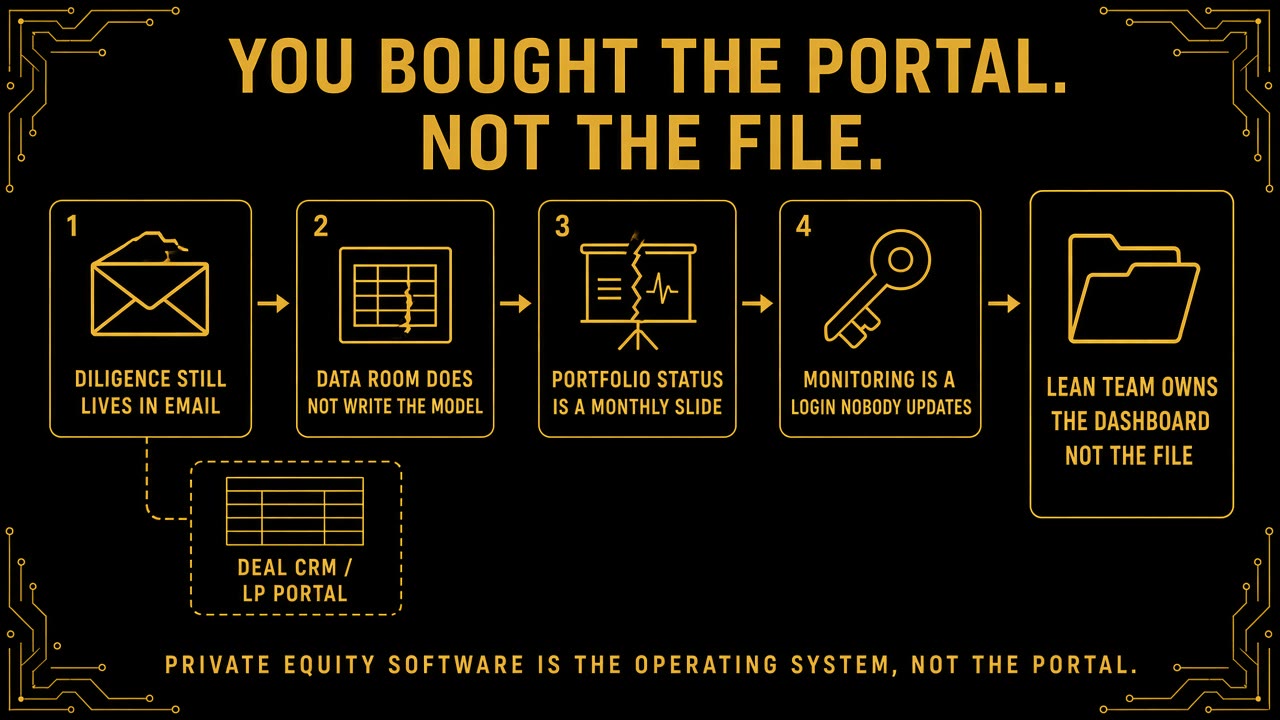
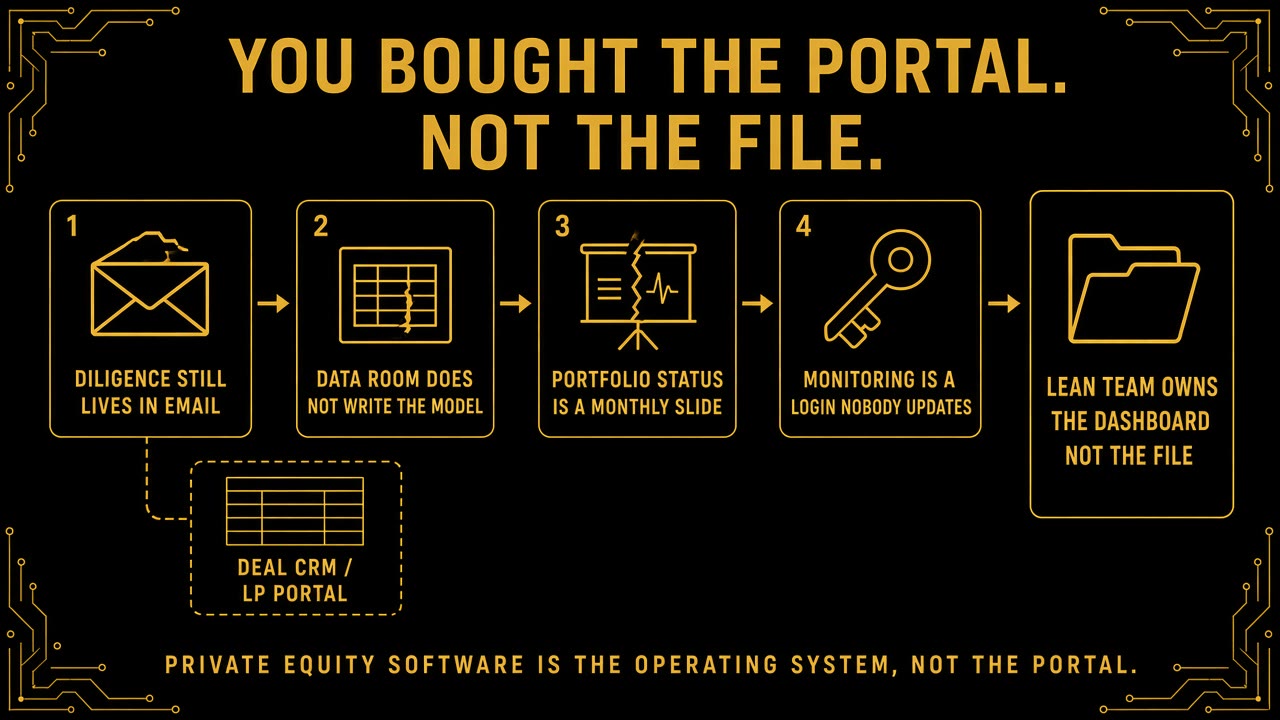
The diagram is the finding. Diligence that never leaves email. A data room that does not write the model. Portfolio status that is a slide. Monitoring that is a login. That chain is a portal you cannot operate. The deal CRM is the side path.
What do I take into the next operating meeting?
I take the objects that decide Monday. I stop.
The finding that wrote into the model. The data-room path a second person used. The weekly pack with owners. The exception list, not the wallpaper. The login the team no longer walks around.
If those are clean, the vendor matrix can wait. If they are not clean, the vendor matrix does not matter yet.
I do not ask a PE software vendor how they feel about the roadmap. I ask whether diligence reached the model this week, and whether anyone besides the usual person can rebuild the portfolio file. Either it did or it did not. If it did not, keep the cash. The portal will still be in the deck.
Related reading
- Technology Due Diligence Checklist for Private Equity and Mid-Market Acquirers
- Technical Due Diligence for PE and Mid-Market Buyers
- Software Due Diligence for PE and Mid-Market Buyers
- Technology Value Creation Plan for PE Portfolio Companies: A 100-Day Playbook
- Technology Due Diligence Consulting for PE and Mid-Market Buyers
Frequently asked questions
What is private equity software?
Private equity software is the operating system a lean PE, mid-market, or family-office team uses to write diligence into the deal model and turn portfolio monitoring into a weekly file someone can act on. I look at whether the data room updates the model, and whether portco status is more than a slide. A deal CRM or LP portal can be true and still leave you operating from email.
What private equity software do lean teams actually need?
Lean teams need two loops they can run without a platform migration. Diligence that writes findings into price, holdback, reserve, or timing. Portfolio monitoring that produces a weekly operating file with owners, not a monthly slide. If the product cannot do those two jobs, it is a login. It is not private equity software.
How is this different from a deal CRM or an LP portal?
A deal CRM stores pipeline. An LP portal stores reporting for limited partners. Private equity software is the work the operating partner still has to do after both of those logins exist. If diligence notes never reach the model, and portco status still lives in email, you bought a portal. You did not buy the file.
How should a lean PE team automate diligence?
Automate the path from a live file to a finding finance can use. Evidence, model effect, close condition or first-100-day action. Do not automate a questionnaire that produces another PDF. The PE technology due diligence checklist and the technical due diligence page are the cousin reads for what belongs in that finding. This page is the software that has to carry it week to week.
When should I hire an operator instead of buying another PE platform?
Hire an operator when a deal is heading to IC, when portfolio monitoring is still a slide, or when the office has no week-to-week technology owner. Start in chat or see the PE engagements. Do not start by buying another portal and hoping the file writes itself.
Working a live deal?
Book a 30-minute working session.
Same operator who runs the diligence engagements. No SDRs, no sales team. Bring the target, I'll bring the checklist.
Share this article
Anthony Wentzel
Founder, Pineapples
Anthony Wentzel has spent 26 years helping mid-market, PE, and family-office operators turn technology risk into decisions they can own. He is the founder of Pineapples.