
Family Office Technology: Owned Workflows, Not a Rented OS
Anthony Wentzel
Founder, Pineapples

Family Office Technology: Owned Workflows, Not a Rented OS
Family office technology is an operator who builds owned workflows on the family's data perimeter, not a rented family-office operating system. Pineapples prices Fractional CTO at $15K or $35K a month, Technology Diligence at $25K or $60K, and AI-Native Build from $4,500 per 2-week sprint. Book a family-office or PE working session.
What is family office technology?
Family office technology is the hired stack plus the person who will run it. A principal, operating partner, or family member who already owns the books brings in an operator. That operator reads the reporting cadence, the deal files, and the knowledge that sits with one person. Then they build workflows the family keeps.
The useful form of that work is AI-native transformation. Strategy plus engineering on retainer. AI-native software delivery applied to a lean office. It is not a product tour. It is not a second login next to the real work.
The job answers three questions the office already has:
- Which recurring pack can run without the same person rebuilding it every cycle?
- Which live deal needs a priced read before IC, not another spreadsheet tab?
- Which portfolio-company status still lives in email, and who owns the next version?
A family office technology program that stops at seats and a vendor roadmap has not changed the office. The data is still wherever the last file landed. Buying another operating system does not put an owner on the perimeter.
Pineapples runs this as owner-led work. Same operator from the working session to the first owned workflow. The published PE and family-office menu lives on the PE engagements page.
Why do spreadsheets fail inside a lean family office?
Spreadsheets fail because a lean office uses them as the operating system.
That looks ordinary until a cycle breaks:
- Two people edit two copies. Nobody can say which one the principal saw.
- The logic lives in a formula only one person trusts.
- A deal file, a K-1 chase, or a portco update sits in a tab with no owner and no date the family can audit.
- The next reporting week cannot start until that person is back.
None of that is a software-preference debate. It is a perimeter problem. The family's books, deal files, and portfolio status are the system of record. A shared workbook is a scratch pad that escaped.
The same gap shows up when the office is underwriting or holding a company. A technology value creation plan that still depends on one spreadsheet will not survive the first 100 days. The cheaper time to put recurring work on owned workflows is before the next IC or the next board week.
Family office technology does not mean deleting spreadsheets on day one. It means stopping the office from treating them as the only place the truth can live.
What should a lean family office automate first?
Automate the work the office already repeats. Do not start with a platform that claims to be the whole office.
Inside a lean shop, the first owned workflows are usually:
- The reporting pack the family already asks for. Same questions every cycle. Same sources. Same person who currently rebuilds it.
- Deal intake on a live file. Data-room triage, a first read, and a list of what still has no owner. If the file is heading to IC, that is technology due diligence consulting, not a chatbot on the CIM.
- Portfolio-company status that today lives in email. One digest the principal can read. Exceptions stay human.
- Knowledge that sits with one person. The reconstruction test is simple. If that person is out for a week, which pack, which deal file, and which portco update stop?
Leave these with a human:
- Capital decisions
- Family politics
- Anything that commits money
- The last read before IC
A later wedge exists if the office only wants one production workflow as proof. That is the Starter Workflow Pilot. It is not the first conversation for a family office that needs a week-to-week operator.
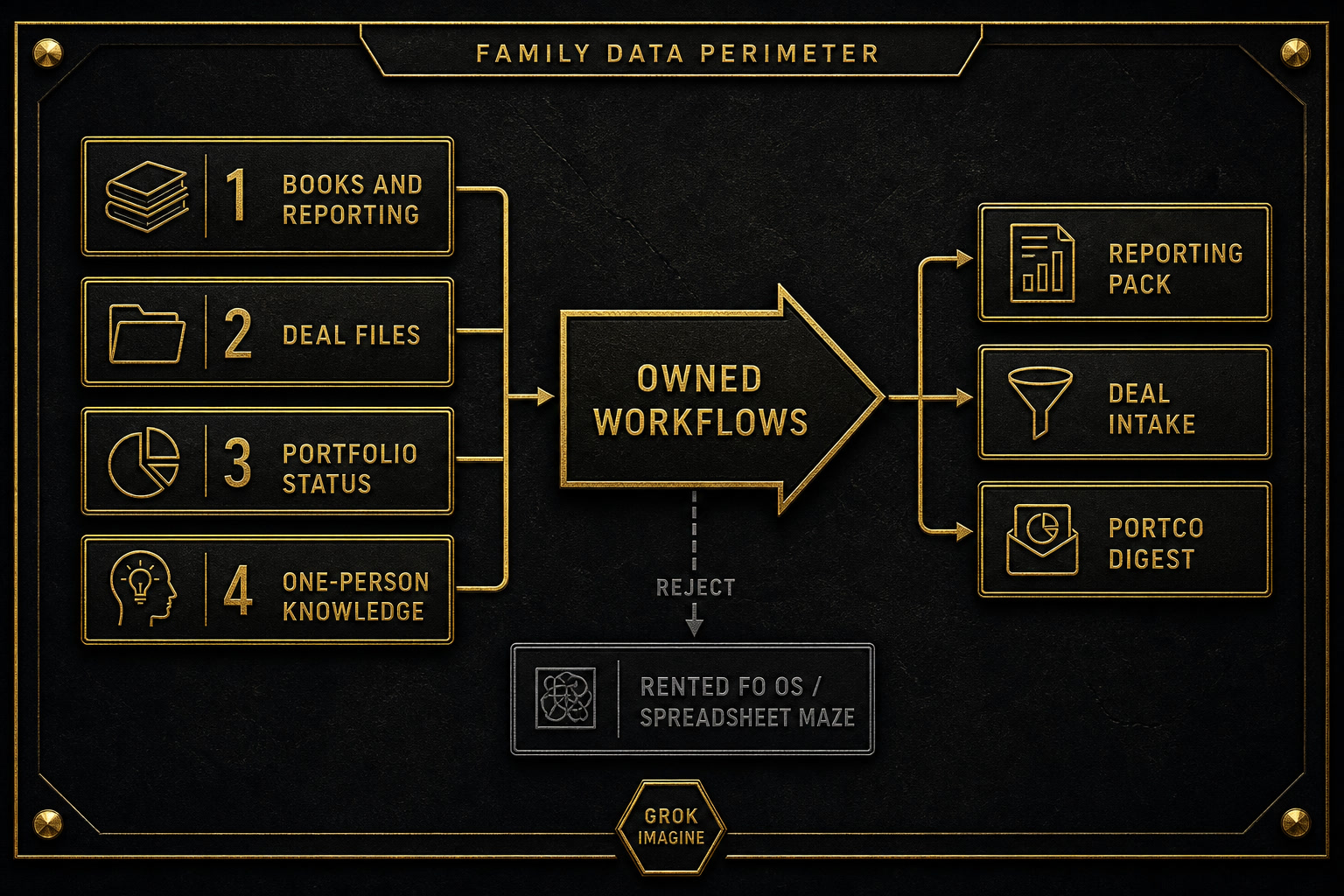
The diagram is the same offer. Four inputs (books and reporting, deal files, portfolio status, one-person knowledge) into owned workflows. Outputs are a reporting pack, deal intake, and a portco digest. The rejected path is a rented family-office OS or a spreadsheet maze.
How is this different from buying a family-office OS vendor?
A family-office OS vendor sells you their model of an office. You rent the tenant. You inherit the roadmap. Implementation becomes a project to make the family's real work look like the product.
Family office technology that an operator owns inverts that.
| Family-office OS vendor | Operator on the perimeter | |---|---| | Their tenant, their objects | The family's books, deal files, and reporting cadence | | A login next to the real work | Workflows the office can keep if the vendor leaves | | Their definition of "the office" | The three or four loops this office actually runs | | A rollout plan | An owner who ships, then stays | | You adapt to the product | The product is built against the perimeter you already have |
Pineapples is the operator seat, not another operating system. Strategy plus engineering. The same person week to week. That is closer to a Tenex-style transformation partner than to a SaaS demo.
If the office later wants software shipped on that perimeter, that is the AI-Native Build on the same menu, from $4,500 per 2-week sprint. If the office needs a week-to-week technology owner, that is the fractional CTO seat at $15K or $35K a month.
Do not buy the OS first and hope an operator can clean it up. Hire the operator. Build what this office actually runs.
When should you hire an operator?
Hire an operator when the next decision is a live deal, a reporting cycle the family cannot reconstruct, or a week-to-week technology seat the office does not have.
The published menu for that work:
- Technology Diligence at $25K or $60K when a file is heading to IC. Ten business days from data-room access. Findings as line items, not a deck with no owner.
- Fractional CTO at $15K or $35K a month when the office needs the same operator every week. Board-ready technology report, architecture and vendor calls, hiring help. Pause or cancel any month.
- AI-Native Build from $4,500 per 2-week sprint when the work is real software on the family's stack.
Those are the live fees on the PE engagements page. This page does not invent others.
The $4,900 Starter Pilot is a later wedge. Use it after the operating model is set, if the office only wants one proof workflow. It is not the hero offer for a family office or PE working session.
Do not hire an operator to decorate a binder. Do not hire one to sit through another OS demo. Do not hire one if there is no recurring work and no live file.
If the office is ready to own the workflows, book a family-office or PE working session. Same operator. Owned workflows on the family's data perimeter.
Related reading
Frequently asked questions
What is family office technology?
Family office technology is the stack and the operator that run the family's books, deal files, and reporting on the family's data perimeter. The useful buy is strategy plus engineering on retainer, not a rented family-office operating system. The published Pineapples menu for that work is Fractional CTO at $15K or $35K a month, Technology Diligence at $25K or $60K, and AI-Native Build from $4,500 per 2-week sprint.
Why do spreadsheets fail inside a lean family office?
Spreadsheets fail when the office treats a shared file as the system of record. Versions drift, one person holds the logic, and the next deal or reporting cycle cannot be reconstructed without that person. Family office technology that works puts the recurring work into owned workflows the family can audit, pause, and keep.
What should a lean family office automate first?
Automate the recurring pack the family already asks for, deal intake on a live file, and portfolio-company status that today lives in email. Leave capital decisions, family politics, and anything that commits money with a human. Do not start by buying a full family-office operating system.
How is family office technology different from buying a family-office OS vendor?
A family-office OS vendor rents you their model of an office and their tenant. Family office technology that an operator builds is owned workflows against the family's books, deal files, and reporting cadence. You keep the perimeter. You do not inherit someone else's roadmap.
When should a family office hire an operator?
Hire an operator when a deal is heading to IC, when the office has no week-to-week technology owner, or when you need software shipped on the family's stack. Book a family-office or PE working session. Fractional CTO is $15K or $35K a month. The $4,900 Starter Pilot is a later wedge if you only want one proof workflow after the operating model is set.
Working a live deal?
Book a 30-minute working session.
Same operator who runs the diligence engagements. No SDRs, no sales team. Bring the target, I'll bring the checklist.
Share this article
Anthony Wentzel
Founder, Pineapples
Anthony Wentzel has spent 26 years helping mid-market, PE, and family-office operators turn technology risk into decisions they can own. He is the founder of Pineapples.