
What an MVP Development Company Owes You on Tuesday

Anthony Wentzel
Founder, Pineapples
What an MVP Development Company Owes You on Tuesday
An MVP development company is the firm you hire to put a real user into a system of record, not the firm that hands you a deck, a clickable prototype, or a sixteen-week Gantt labeled MVP. If that user cannot log in, finish the one workflow, and leave a record someone else can audit, you do not have an MVP. You have a demo.
I write this for the PE operating partner and the mid-market founder who typed the phrase because a portco needs a wedge in production. I am not writing another vendor RFP. The seven vendor-selection criteria and 9 to 12 week timeline already live on that page.
What is an MVP development company actually selling?
Monday kickoff. The shop asks for personas and a Figma file. By Friday you have a timeline, a RACI, and a Slack channel. Nobody has named the person who will log in next Tuesday.
That is the usual sale. It looks like a company. It is a staffing conversation with better slides.
What the phrase should mean is narrower. One owner who will still pick up in week 3. One system of record the build writes. One live user path. That is the company. A bench that can staff six roles by Wednesday is inventory. The staff augmentation versus managed team split is the same argument in a different costume. Capacity is not a login.
Buyers also type MVP development services and MVP app development company. Same Tuesday. Different labels. I am not opening those slugs here.
Why do PE and mid-market buyers still type this phrase?
Not because they want a startup incubator story. A portco already has customers, a ledger, and a board date. They need a wedge that writes into the stack they already pay for.
The search box still says MVP development company because procurement language won the SERP. Listicles. Offshore service pages. Shops that treat "MVP" as a package name. An operating partner heading into a hold-period plan is not shopping a 30-day founder roadmap. They are shopping a production write.
That is why this page is not a scale-path essay. The 100-day technology value creation plan is the hold-period document. This page is the first live user.
If the shop cannot name the user, the workflow, and the system that will hold the row, they are pitching a demo in company clothing.
What is the Tuesday test?
I do not score vendors. I sit next to an actual user.
The test is three actions, not three principles.
They log in with a credential the company owns. Not a vendor demo account. Not a shared password in the agency's 1Password.
They complete the one workflow the build was sold to do. One. Create the exception. Post the receipt. Open the case. Whatever you bought.
They leave a record in the system of record that a second person can open on Wednesday without a walkthrough. Timestamp. Id. A row finance or ops can find without the vendor on Zoom.
Tuesday, 9:40. You are in the portco conference room, not in a showroom. The ops lead types the password. The app loads. They finish the workflow. You open the ERP or the CRM as yourself. The row is there, or it is not.
A Figma cannot do that. A prototype that writes to a mock API cannot do that. A Gantt that parks "UAT" in week 14 cannot do that. If the record is missing, the milestone was theatre.
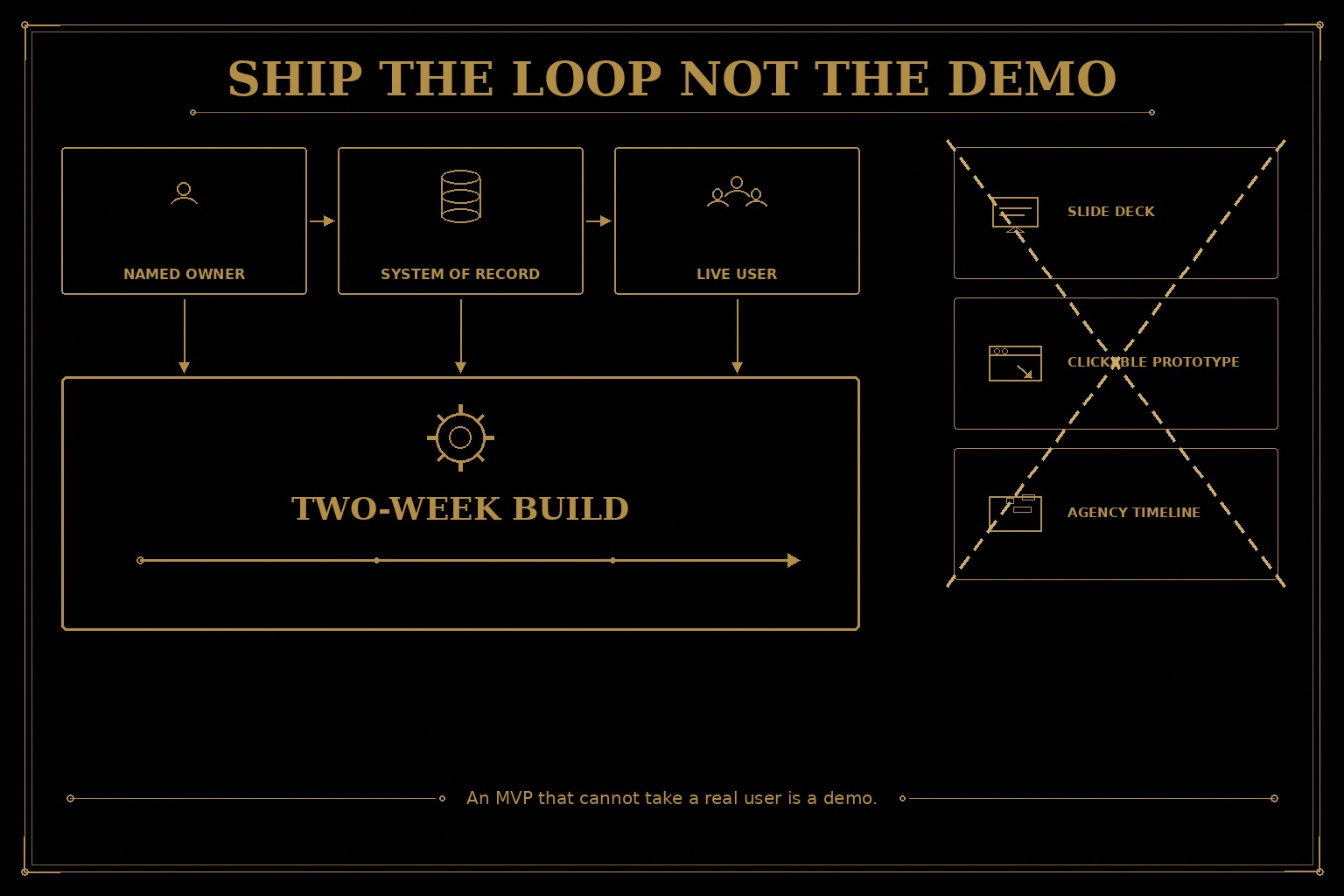
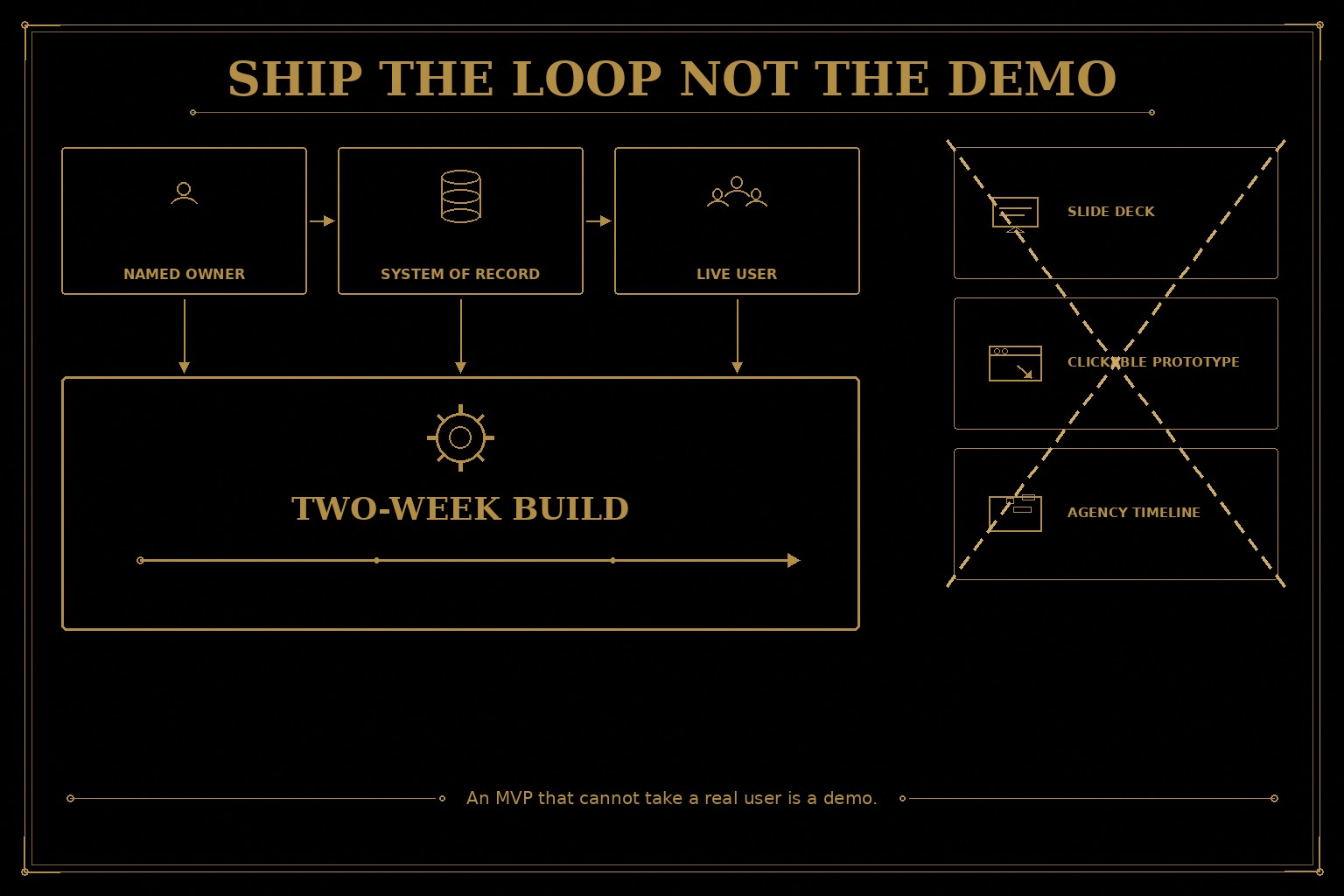
The diagram is the deliverable. Named owner. System of record. Live user. Those three feed a two-week build. The slide deck, the clickable prototype, and the agency timeline are the rejected path.
Which deliverables fail that test?
I keep seeing the same four. They are unique to this search. They all survive a status meeting and die on Tuesday.
Figma as the MVP. Frames. Flows. A prototype link in the Slack channel. Nobody logs in. The system of record never sees a write. You paid for a conversation about the product.
Clickable prototype as the milestone. Week 6. A browser mock. The cursor works. Buttons highlight. The ERP does not get a row. The shop calls it validation. It is a movie of the workflow.
Sixteen-week agency Gantt labeled MVP. Discovery. Architecture. Design. Build. QA. UAT. The live user is a phase near the end. Phases are how a demo hides inside a professional plan. If you already have a slipping Gantt, that is a software project rescue problem, not a longer discovery.
Offshore body shop, no named owner after week 2. The standup still happens. Tickets move. The person who scoped Tuesday is already on another account. The user has a coordinator. Coordinators do not own a failed login.
A six-week slip on a deck is annoying. A six-month slip on the workflow that was supposed to take a customer is an operating risk. The Tuesday test is how you find that out while the cash is still yours.
What does company mean versus a staffed bench?
Company means the same person will still answer when the login fails. It means the write lands in a system the portco already treats as true. It means one user path, not a catalog of roles.
A staffed bench means a Slack channel, a Jira project, and a rate card. After week 2 the "owner" is whoever is on the standup. That is a dedicated development team conversation if you already have architecture and an internal lead. It is the wrong buy when you still need Tuesday to work.
I do not hire a bench to invent the first live path. I hire a company that will sit next to the user and stay on the row until a second person can find it.
If the proposal lists roles before it lists the user, you are buying hours. Hours do not leave an audit trail.
What should you walk away with on Friday of week two?
A login the company owns. One finished workflow. A record a second person can audit without the vendor.
That is the whole receipt. I do not want a longer Gantt if Friday cannot take a user. I want a different company.
Pineapples prices that live loop as AI-Native Build from $4,500 per 2-week sprint. Same operator from kickoff to the Tuesday sitting. A later single proof workflow, after the path is obvious, is the Starter Workflow Pilot at $4,900, 7 business days. Those are the live fees. This page does not invent others.
I run this as owner-led work. Strategy plus engineering in the same seat. Not a deck shop. Not a body shop that vanishes after week 2.
If you have a portco that needs a wedge in production, scope the two-week loop. Bring the user. I will sit next to them on Tuesday.
What do I take into the next operating meeting?
I take the login, the workflow, and the row. I stop.
If the row is there, the deck can wait. If the row is not there, the deck does not matter yet.
I do not ask the shop how they feel about the sprint. I ask a second person to open the record. Either it is there or it is not. If it is not there, keep the cash. The slide deck will still be in the folder.
Related reading
- How to Choose an MVP Development Company (Mid-Market Launch Guide)
- Staff Augmentation vs Managed Teams for Mid-Market Companies
- Software Project Rescue: What Mid-Market CEOs and COOs Should Do First
- Why Software Delays Become an Operating Risk for Mid-Market Companies
- Dedicated Development Team for Mid-Market Companies
Frequently asked questions
What is an MVP development company?
An MVP development company is the firm you hire to put a real user into a system of record. The user logs in, finishes the one workflow you bought, and leaves a record a second person can audit. A shop that delivers a deck, a clickable prototype, or a sixteen-week Gantt labeled MVP is selling a demo.
What is the Tuesday test for an MVP?
Sit next to an actual user. They log in with a credential the company owns. They complete the one workflow. They leave a record in the system of record that someone else can open on Wednesday without a walkthrough. If any of those fail, the milestone was a demo no matter how many screens shipped.
How is this different from a mid-market launch guide?
The mid-market launch guide is a vendor-selection page. It walks seven criteria and a 9 to 12 week timeline. This page is the Tuesday login. I do not score shops. I sit next to the user and look for the record.
Which deliverables should I reject from an MVP shop?
Reject Figma sold as the MVP. Reject a clickable prototype as the milestone. Reject a sixteen-week agency Gantt that parks the live user in week 14. Reject an offshore bench that has no named owner after week 2. Those artifacts can look busy and still leave the system of record empty.
How does Pineapples price a two-week live loop?
Pineapples prices the live loop as AI-Native Build from $4,500 per 2-week sprint. A later single proof workflow is the Starter Workflow Pilot at $4,900, 7 business days. Those are the live fees. This page does not invent others.
Working a live deal?
Book a 30-minute working session.
Same operator who runs the diligence engagements. No SDRs, no sales team. Bring the target, I'll bring the checklist.
Share this article
Anthony Wentzel
Founder, Pineapples
Anthony Wentzel has spent 26 years helping mid-market, PE, and family-office operators turn technology risk into decisions they can own. He is the founder of Pineapples.