
Agentic Workflows for PE and Mid-Market Operators

Anthony Wentzel
Founder, Pineapples
Agentic Workflows for PE and Mid-Market Operators
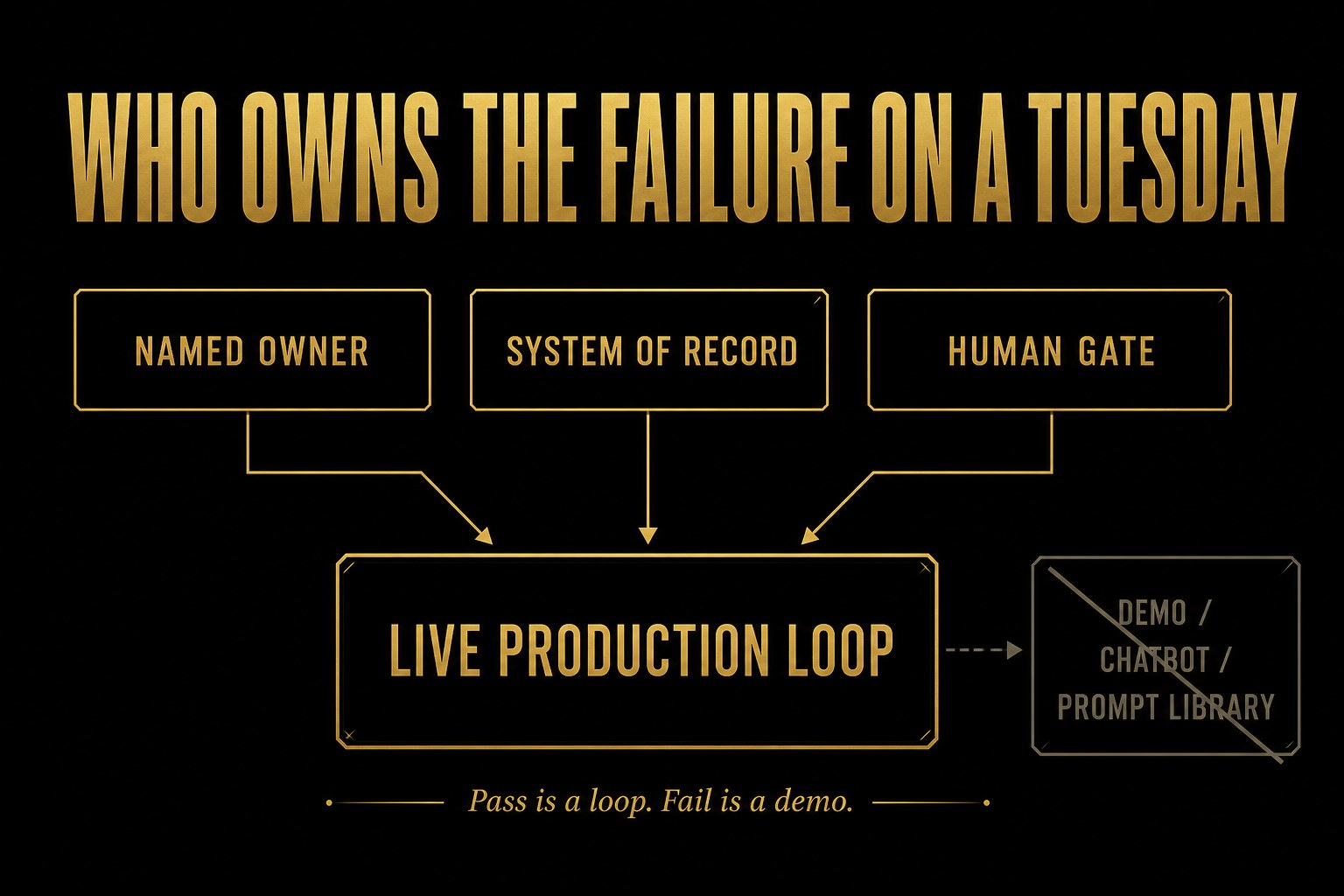
An agentic workflow is a production loop with a named owner, a system of record it can read and write, and a human gate on the exception. It is not a demo. It is not a chatbot. It is not a prompt library.
The pages that rank for this phrase today are written for developers. They talk about agents in a repo, tool calling, and how to wire a model to GitHub. That is a real craft. It is not the operator question. The operator question is who owns the failure on a Tuesday.
Pineapples prices the working version of that loop as Fractional CTO at $15K or $35K a month, or Technology Diligence at $25K or $60K when the file is live. Book a PE working session, not a product tour.
What is an agentic workflow?
An agentic workflow is a hired loop that already belongs to the company. An agent reads a system of record you already trust. It does the recurring work. It writes the result back. When the case is weird, a named person takes the gate.
That is strategy plus engineering. Same person who names the loop should be able to ship it. It is the AI-native software delivery test applied to one production path, not to an engineering org chart.
It is not:
- A chatbot that answers and stops
- A prompt library in a shared drive
- A vendor demo on sample data
- A Copilot seat count
- A weekend agent that never writes back
A demo can look smart in a board room. An agentic workflow reconstructs last Tuesday's exception without the one person who knows the spreadsheet. If you cannot name that person, you do not have a workflow. You have a conversation.
A family office has the same test on a thinner bench. The books, the deal file, and the reporting pack either run as owned loops on the family's perimeter, or they live in a rented login next to the real work.
What should you test before you call it agentic?
Test three things. Do not test the logo wall.
- Owner. Who owns the failure on a Tuesday? Title is not enough. Name the person who will pause the workflow, explain the miss, and keep the exception human.
- System of record. Can the loop read and write the stack you already pay for? If the agent only talks, and the truth still lives in a mailbox, you scored a demo.
- Human gate. Which exception stays with a person? A loop with no gate is a leak. A loop that sends every case to a person is a chatbot with extra steps.
Those three are the inputs. The output is not a framework diagram. The output is one live loop.
If you cannot score those three yet, stop. Run an AI readiness assessment first. That page is the 2-3 week read on data, systems, ownership, change capacity, and security. This page is the loop you ship after the roster exists.
How is this different from the GitHub framing?
Search results for agentic workflows are written for people who live in a repository. They explain agents, tool calling, and how to hook a model to a pull request. AI code review tools is that lane. Pick the scanner for the bug class you actually have.
That is useful work. It is not this work.
The operating partner, the mid-market COO, and the family-office principal are not asking how to wire an agent to GitHub. They are asking who owns the miss when the loop writes the wrong number into the system of record. A developer page can skip that question. An operator page cannot.
If your agentic workflow only exists in a repo, you built a developer tool. If it reads and writes the books, the deal file, or the weekly pack, and a named person owns the exception, you built an operating loop.
How should a PE or mid-market operator ship the first one?
Do not start with a platform. Start with one loop you already run.
Name the loop. A reporting pack. An exception queue. A deal-intake file. A portco digest. If you cannot name it, you are not ready to buy software.
Name the system. The agent has to read and write something the company already treats as true. If two people can produce two official numbers for the same week, you do not have a system of record. You have files.
Name the owner. The person who will still be here next Tuesday. A mid-market operator who already has a technology seat should use the first weeks as the start of a Fractional CTO retainer. Same person week to week. If a deal is heading to IC, the first pass looks like technology due diligence. Ten business days from data-room access is the published diligence clock.
Keep the exception human. Capital decisions, anything that commits money, and the case the model has not seen stay with a person. The happy path should get boring. The weird cases should get louder.
Do not stretch the first loop into a quarter. A long build is usually a platform search dressed as a workflow. Two weeks is enough to see whether the loop can read, write, and stop.
What does a pass or fail look like?
Pass. You can name the owner. There is a system of record the agent can touch. One loop can ship without inventing a new platform. Someone can explain the human gate in a sentence. The company can absorb that loop in the next month, not the next fiscal year.
Conditional. The pieces exist if you make two calls this week. Name the owner. Pick one source of truth. Until those two are done, do not buy seats.
Fail. Nobody owns the work after the demo. Data is a maze. The ask is "stand up agents and see." A prompt library with nobody on the roster is still a fail.
Pass and fail are operator judgments. This page does not invent a scoring rubric with fake cutoffs. If the loop cannot survive a board question about who pauses it, it failed.
What do you do after the first loop is live?
Do the next thing the roster can actually run.
- Pass. Keep the same operator. Put them on the next loop. That is the Fractional CTO seat at $15K or $35K a month, pause or cancel any month. Software on that perimeter is AI-Native Build from $4,500 per 2-week sprint.
- Conditional. Hire or assign the owner before you buy a platform. The first attempt just told you the seat is empty. Filling the seat is the work.
- Fail. Do not buy the platform. Do not add a second agent. Fix ownership and the system of record, or admit the constraint is not the model.
If you only want one production workflow as proof after the operating model is set, the later wedge is the Starter Workflow Pilot at $4,900, 7 business days. That is not the identity of this page. The identity is the operator seat. How much AI automation costs is the price ladder for a single workflow, not the PE loop conversation.
Those are the live fees on the PE engagements page. This page does not invent others.
Who owns the failure on a Tuesday?
The workflow dies the moment it becomes a demo reel.
A useful loop names three things and stops:
- The person who owns it
- The system of record it reads and writes
- The exception that stays human
If you cannot write those three on one page, you are not ready. Buy nothing until you can. The GitHub tutorial will still be there next quarter. The owner will not appear because a slide said "agentic."
Pineapples runs this as owner-led work. Same operator from the working session to the first live loop. Strategy plus engineering on retainer. Not a cheap automation shop. Not a prompt library with a logo.
If the file is live or the CTO seat is empty, book a PE working session. Same operator. Ship the loop, not the demo.
Related reading
- AI Readiness Assessment for PE and Mid-Market Operators
- AI-Native Software Delivery for Mid-Market
- AI Code Review Tools in 2026: Pick the Tool for the Bug You Have
- How Much Does AI Automation Cost?
- Fractional CTO Services for Mid-Market Companies
- Technology Due Diligence Consulting for PE and Mid-Market Buyers
Frequently asked questions
What is an agentic workflow?
An agentic workflow is a production loop that already runs on a real system of record, with a named owner and a human gate on the exception. An agent can read and write the same source of truth the company already trusts. A person pauses the miss, explains it, and keeps the weird case human. It is not a demo, a chatbot, or a prompt library.
How is an agentic workflow different from a chatbot or a prompt library?
A chatbot answers a question and stops. A prompt library is a folder of starting text. An agentic workflow closes a recurring loop in the stack you already pay for. It reads the system, does the work, writes back, and stops for a person when the case is an exception. If nothing writes back and nobody owns a miss, you bought a conversation.
What three tests should a PE or mid-market operator use on an agentic workflow?
Name the owner who will pause a miss on a Tuesday. Name the system of record the loop can read and write. Name the exception that stays human. If any of those three is missing, you have a demo. Run an AI readiness assessment before you buy a platform so you score data, systems, ownership, change capacity, and security first.
Who should own an agentic workflow after it ships?
A named operator, not a vendor login and not a rotating committee. Title is not enough. The person has to be able to pause the loop, explain the miss, and keep the exception human. On a live portco that is the Fractional CTO seat at $15K or $35K a month. On a live file it is Technology Diligence at $25K or $60K. Software on that perimeter is AI-Native Build from $4,500 per 2-week sprint.
What should you do after the first agentic workflow is live?
Keep the same owner and pick the next loop. Do not buy a second platform because the first one shipped. If you only want one proof workflow after the operating model is set, the later wedge is the $4,900 Starter Workflow Pilot. The identity of the work is the operator seat, not the pilot.
Working a live deal?
Book a 30-minute working session.
Same operator who runs the diligence engagements. No SDRs, no sales team. Bring the target, I'll bring the checklist.
Share this article
Anthony Wentzel
Founder, Pineapples
Anthony Wentzel has spent 26 years helping mid-market, PE, and family-office operators turn technology risk into decisions they can own. He is the founder of Pineapples.