
AI Readiness Assessment for PE and Mid-Market Operators

Anthony Wentzel
Founder, Pineapples

AI Readiness Assessment for PE and Mid-Market Operators
An AI readiness assessment is a 2-3 week operator read on whether a mid-market or PE-backed company can put AI on real systems with a named owner. It scores data, systems, ownership, change capacity, and security, then names who runs the first workflow. It is not a vendor maturity quiz, a Copilot seat count, or a slide deck with no roster.
Pineapples prices the working version of that read as Fractional CTO at $15K or $35K a month, or Technology Diligence at $25K or $60K when the file is live. Book a PE working session, not a product tour.
What is an AI readiness assessment?
AI readiness assessment is a hired operator sitting in the company for a short clock and answering one question. Can this team put AI on a system of record, with a person who will own it after the readout?
That is strategy plus engineering. Same person who scores the stack should be able to ship the first workflow. It is the AI-native software delivery test applied before anyone buys a platform.
It is not:
- A vendor maturity quiz that ends in a tool matrix
- A Copilot or ChatGPT Enterprise seat count
- A 90-day "AI strategy" deck with no owner
- A survey the IT team fills in between tickets
A quiz can tell you that you have Microsoft 365 and a data lake. An operator assessment tells you whether last Tuesday's invoice, exception, or portco pack can be reconstructed without the one person who knows the spreadsheet. If the readout cannot name that person, you assessed a catalog. You did not assess readiness.
A family office has the same test on a thinner bench. The books, the deal file, and the reporting pack either have an owner on the family's perimeter, or they live in a rented login next to the real work.
What should you score?
Score the five things a vendor quiz usually skips. Do not score the logo wall.
- Data. Is there a system of record an agent can read, or only a shared drive and a mailbox? If two people can produce two different "official" numbers for the same week, you do not have data. You have files.
- Systems. Can anything write back into the stack you already pay for? An assessment that cannot name the API, the export, or the human-in-the-loop gate is scoring a demo, not a system.
- Ownership. Who owns the failure on a Tuesday? Title is not enough. Name the person who will pause the workflow, explain the miss, and keep the exception human.
- Change capacity. Can this company absorb one live workflow without a nine-month program office? If every change still needs a steering committee, the model is not the bottleneck. The calendar is.
- Security. What data can leave the perimeter, who approves it, and what never should? Readiness that ignores this is a leak with a roadmap.
Those five are the inputs. The output is not a heat map. The output is a roster and a first workflow.
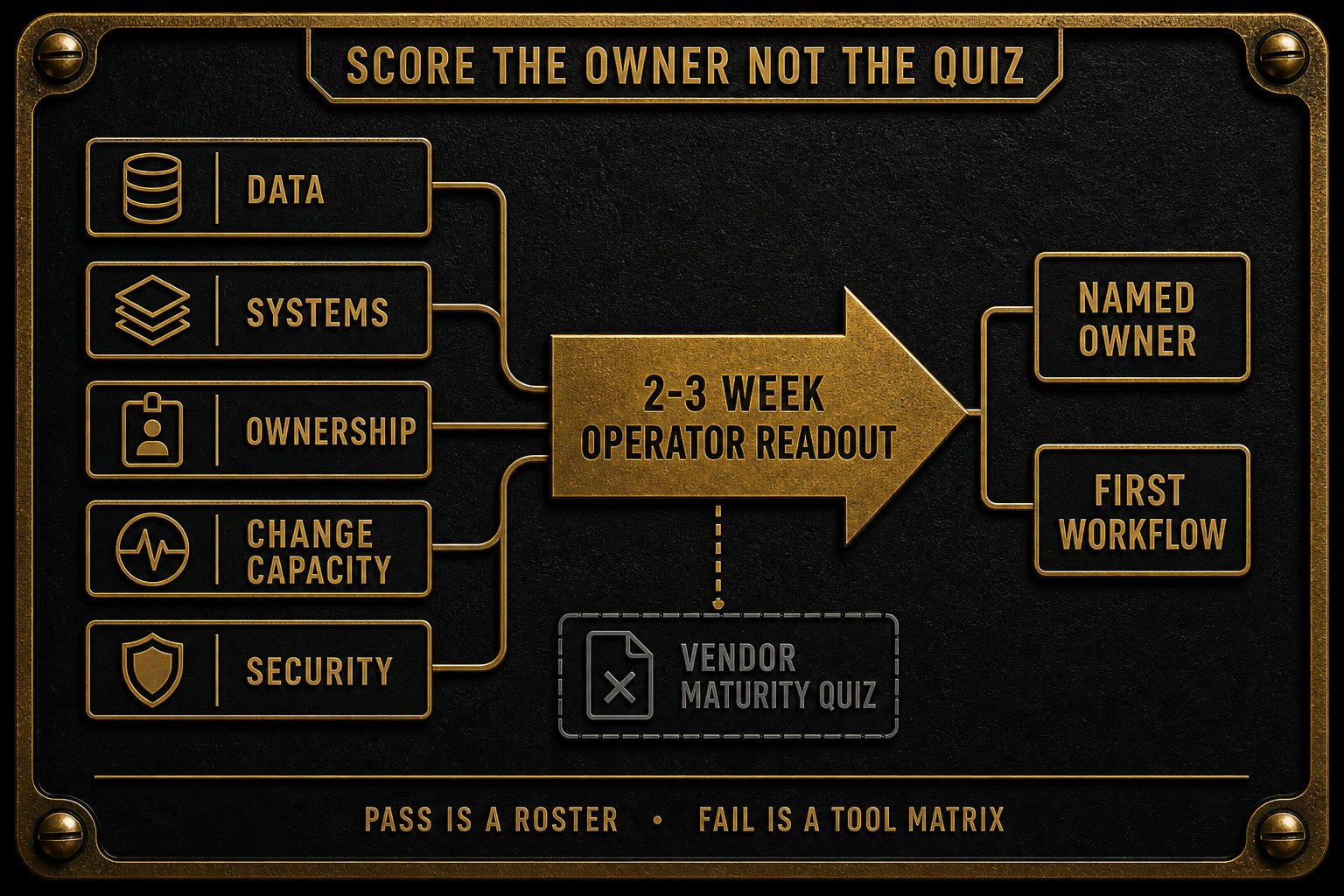
The diagram is the same offer. Five inputs into a 2-3 week operator readout. Outputs are a named owner and a first workflow. The rejected path is a vendor maturity quiz. Pass is a roster. Fail is a tool matrix.
How should a PE or mid-market operator run one in 2-3 weeks?
Run it as a working engagement. Do not send a survey.
Week 1. Map where truth lives. Sit with the people who already close the week. Ask which system they actually trust, which spreadsheet they still rebuild, and who is the single point of failure. List the systems an agent would have to read and write. If a deal is heading to IC, this week looks like the first pass of technology due diligence consulting. Ten business days from data-room access is the published diligence clock.
Week 2. Score the five, then pick one workflow. Write the score as decisions, not colors. Data is a source of truth or it is not. Ownership is a name or it is not. Then pick one recurring loop that would prove the score: a reporting pack, an exception queue, a deal-intake file, a portco digest. If you cannot name the loop, you are not ready to buy software.
Week 3. Read out a roster and a next action. The artifact is a one-page owner map plus the first workflow you would ship. Not a 40-row tool comparison. The next action is hire the owner, keep the owner, or stop. A mid-market operator who already has a technology seat should use these weeks as the start of a Fractional CTO retainer. Same person week to week.
Do not stretch this into a quarter. A long assessment is usually a delay dressed as diligence. Two or three weeks is enough to see the perimeter, the people, and the first loop. It is not enough to pretend you transformed the company.
What does a pass or fail look like?
Pass. You can name the owner. There is a system of record an agent can touch. One workflow can ship without inventing a new platform. Someone can explain the security perimeter in a sentence. The company can absorb that workflow in the next month, not the next fiscal year.
Conditional. The pieces exist if you make two calls this week. Name the owner. Pick one source of truth and stop treating the shared drive as the system. Until those two are done, do not buy seats.
Fail. Nobody owns the work after the readout. Data is a maze. Security is a hope. The ask is "buy Copilot and see." A tool matrix with every box green and nobody on the roster is still a fail.
Pass and fail are operator judgments. This page does not invent a scoring rubric with fake cutoffs. If the readout cannot survive a board question about who runs the first workflow, it failed.
What do you do after the readout?
Do the next thing the roster can actually run.
- Pass. Keep the same operator. Put them on the first workflow, then the next. That is the Fractional CTO seat at $15K or $35K a month, pause or cancel any month. Software on that perimeter is AI-Native Build from $4,500 per 2-week sprint.
- Conditional. Hire or assign the owner before you buy a platform. The assessment just told you the seat is empty. Filling the seat is the work.
- Fail. Do not buy the platform. Do not run a second quiz. Fix ownership and the system of record, or admit AI is not the constraint.
If you only want one production workflow as proof after the operating model is set, the later wedge is the Starter Workflow Pilot at $4,900, 7 business days. That is not the identity of this page. The identity is the operator seat. How much AI automation costs is the price ladder for a single workflow, not the PE readiness conversation.
Those are the live fees on the PE engagements page. This page does not invent others.
Who owns the work after the score?
The assessment dies the moment it becomes a tool matrix.
A useful readout names three things and stops:
- The person who owns the first workflow
- The system of record that workflow reads and writes
- The exception that stays human
If you cannot write those three on one page, you are not ready. Buy nothing until you can. The vendor quiz will still be there next quarter. The owner will not appear because a slide said "high readiness."
Pineapples runs this as owner-led work. Same operator from the working session to the first workflow. Strategy plus engineering on retainer. Not a cheap automation shop. Not a quiz landing page.
If the file is live or the CTO seat is empty, book a PE working session. Same operator. Score the owner, not the quiz.
Related reading
Frequently asked questions
What is an AI readiness assessment?
An AI readiness assessment is a 2-3 week operator read on whether a mid-market or PE-backed company can put AI on real systems with a named owner. It scores data, systems, ownership, change capacity, and security, then names who runs the first workflow. It is not a vendor maturity quiz, a Copilot seat count, or a slide deck with no roster.
What should an AI readiness assessment score?
Score five things a vendor quiz usually skips. Data, whether a system of record exists that an agent can read. Systems, whether write-back is possible without a shadow spreadsheet. Ownership, the named person who owns a failure on a Tuesday. Change capacity, whether the company can absorb one live workflow without a nine-month program. Security, what data can leave the perimeter and who approves it.
How should a PE or mid-market operator run an AI readiness assessment?
Run it as a working engagement in 2-3 weeks, not as a survey. Week one maps where truth lives and who owns each system. Week two scores the five dimensions and picks one workflow that would prove the score. Week three is a readout with a roster and a next action. On a live deal, the published Technology Diligence seat is the 10-business-day version. On a live portco, the first weeks of a Fractional CTO retainer are the working version.
What does pass or fail look like on an AI readiness assessment?
Pass means a named owner, a system of record an agent can touch, a first workflow that can ship, and a security perimeter someone can explain. Conditional means those pieces exist if you name the owner and pick one source of truth. Fail means no owner, data in a maze, security as a hope, and a request to buy seats and see what happens. A tool matrix with nobody on it is a fail even if every box is green.
What should you do after an AI readiness assessment?
After a pass, put a named owner on the first workflow and keep the same operator week to week. Pineapples prices that seat as Fractional CTO at $15K or $35K a month. Software on that perimeter is AI-Native Build from $4,500 per 2-week sprint. After a fail, do not buy a platform. Hire the owner first. The $4,900 Starter Pilot is a later wedge if you only want one proof workflow after the operating model is set.
Working a live deal?
Book a 30-minute working session.
Same operator who runs the diligence engagements. No SDRs, no sales team. Bring the target, I'll bring the checklist.
Share this article
Anthony Wentzel
Founder, Pineapples
Anthony Wentzel has spent 26 years helping mid-market, PE, and family-office operators turn technology risk into decisions they can own. He is the founder of Pineapples.