
Application Rationalization During M&A: The Consolidation Cost Buyers Underestimate

Anthony Wentzel
Founder, Pineapples

Application rationalization during M&A is the keep, migrate, consolidate, or retire decision that belongs in the deal model before close. Parallel licenses, hidden integrations, and retirement sequencing are the real cost. Pineapples prices that operator seat as Fractional CTO at $15K or $35K a month.
What is application rationalization during M&A?
Application rationalization during M&A is the hired, priced version of the stack decision. A PE operating partner, family office, or mid-market buyer has to say which systems stay, which move, which merge, and which die. That decision changes the integration timeline, the vendor budget, and the operating model of the combined company.
It is not a cleanup project that starts after the press release. It is not a spreadsheet of vendor names, user counts, and annual cost. Those fields describe the invoice. They do not describe what the business actually uses the application for on a Tuesday morning.
The useful form of the work answers four questions:
- What does this application do that nothing else does?
- What goes dark if we shut it off?
- When does the contract renew relative to a real retirement date?
- Can the same people absorb this work while they keep close, billing, and customers alive?
A portfolio that stops at "we will consolidate the stack" has not done application rationalization. It has written a hope into the model.
That is why this page sits next to the post-merger integration pillar for mid-market PE. The pillar is the operating loop after close. This page is the stack decision that has to be priced before that loop starts.
Why does the deal model miss the real cost?
The model usually has a license line and a retirement date. Both are guesses until someone walks the systems.
Three gaps show up after close.
Stated purpose versus real purpose. The vendor sells a project tool, a reporting layer, or a CRM module. The business may be running pipeline, month-end, or exception handling inside it because the "real" system was too rigid. Retire the label and you open an operating hole.
Dependencies the inventory never listed. One application looks disposable until three others pull data from it. Custom logic, pricing rules, and unofficial feeds sit in the thing you planned to shut down first.
Time as a second invoice. Rationalization does not happen on signing day. While both stacks stay live, you pay two licenses, two support loads, and the risk that transactions split across systems. Savings land later than the model printed. Capacity does not free up when the slide said it would.
None of that requires a new study. It is the same integration-surface problem technology due diligence consulting is supposed to price before IC. If diligence stopped at a stack list, the rationalization cost is still sitting outside the model.
What should buyers verify before they price the stack?
The standard application inventory is a starting file. It is not the diligence.
Walk one real process through each critical application. Not the demo. The Tuesday-morning path the team actually runs. You are looking for the workaround, the customization, and the manual step that the vendor pitch never mentioned.
Decide the data fate before you decide the retirement date. Application retirement is a data decision first. Migrate, archive, or export into a format someone can still read. Mid-market records are inconsistent across years. Fields change meaning. IDs do not match. Making that data usable in the target system is often the longer job.
Pull contracts on material spend. Know the renewal date, the notice period, and whether change-of-control is assignable. A system you plan to retire will often renew at least once before retirement is real. That is a budget line, not a legal footnote.
Test the synergy date against team capacity. Application consolidations compete with cutover, reporting, and the rest of the post-merger integration load. If the model books software savings in month seven and the team cannot move users for fourteen months, the savings are late. Say so before you sign.
The output is not a risk rating. It is a revised synergy date, a parallel-run budget, and a retirement sequence. If a finding cannot be dated or priced, it is not finished.
The self-serve question list lives on the M&A technology due diligence checklist. This page is the operator judgment that turns those answers into a keep, migrate, consolidate, or retire plan.
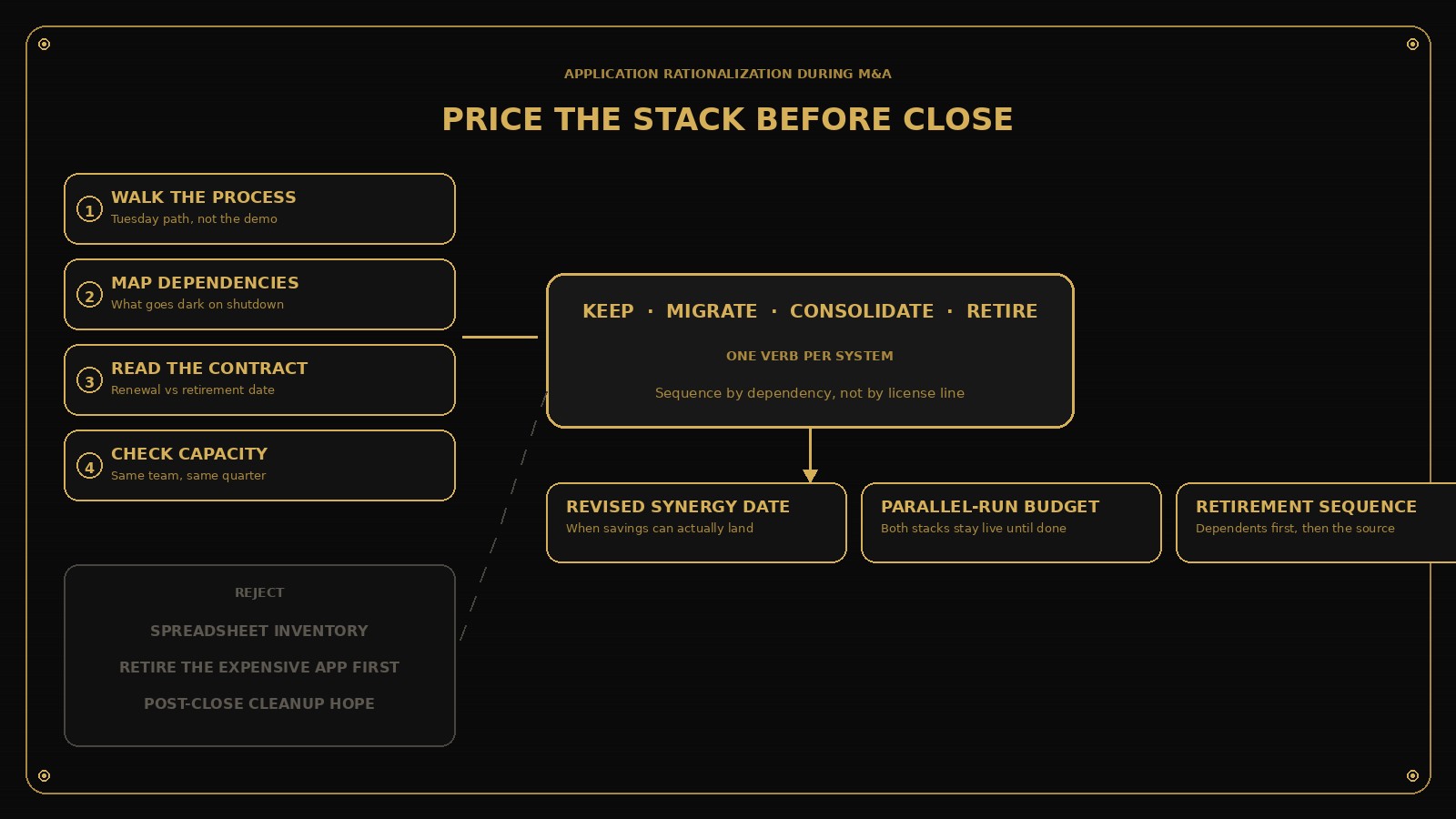
The diagram is the same offer. Four inputs (real process, dependencies, contract, capacity) into one decision: keep, migrate, consolidate, or retire. Outputs are a synergy date, a parallel-run budget, and a retirement sequence. The rejected path is a spreadsheet inventory that retires the expensive app first.
How should you sequence keep, migrate, consolidate, and retire?
Sequence by dependency, not by the largest license line.
The temptation is to retire the most expensive application first because the savings look largest. The expensive application is often the one everything else still drinks from. Touch it before the dependents have a new home and you create a crisis that eats the next two quarters.
A sequence that holds looks like this:
- Name keep, migrate, consolidate, or retire for each critical system. One verb. If you need two verbs, you do not have a decision yet.
- Retire the systems with no downstream dependents first. Those are the only clean wins.
- Hold the systems that still feed close, billing, or customer delivery. Give those dependents a new home before you shut the source off.
- Budget the parallel run as a line, not a hope. Both systems stay live until retirement is real. Price the overlap.
- Keep a contingency for what the inventory missed. Every rationalization finds an undocumented customization, a non-transferable clause, or a migration tool that cannot carry the exceptions.
Do not run this plan as a side project next to the rest of integration. It competes for the same internal IT hours and the same external operators. Put it on the master schedule or it will lose to whichever fire is loudest that week.
When should a PE or family office hire an operator?
Hire an operator when the next decision is a price, a holdback, or a close, and the stack can change that decision. Hire one after close if nobody owns the keep, migrate, consolidate, or retire sequence week to week.
The published menu for that work:
- Technology Diligence at $25K or $60K when a file is heading to IC. Ten business days from data-room access. Findings as line items, including a first pass at the rationalization sequence.
- Fractional CTO at $15K or $35K a month when the portco or office needs the same operator on the sequence every week. Board-ready technology report, vendor calls, integration oversight. Pause or cancel any month.
- AI-Native Build from $4,500 per 2-week sprint when the work is real software, migration, or integration on the combined stack.
Those are the live fees on the PE engagements page. This page does not invent others.
A family office should buy the same seat when the person wearing the operating-partner hat cannot sit in the stack and still own the model. A mid-market buyer should buy it when the thesis depends on combining systems, not only on combining P&Ls. The week-to-week version of that seat is the fractional CTO.
The $4,900 Starter Pilot is a later wedge. Use it after the operating model is set, if you only want one proof workflow. It is not the hero offer for a live deal or a post-close rationalization.
Do not hire an operator to decorate a binder. Do not hire one to retire the expensive app first because the license line is loud. Do not hire one if there is no data-room date and no owner for the sequence.
If you have a live deal or a stack you already closed on, book a PE working session. Same operator. Keep, migrate, consolidate, or retire, priced before the model pretends it is done.
Related reading
Frequently asked questions
What is application rationalization during M&A?
Application rationalization during M&A is the keep, migrate, consolidate, or retire decision for the combined application portfolio. It is a cost and capacity decision that belongs in the deal model before close, not a cleanup project after the press release. The work prices parallel licenses, hidden integrations, and the sequence the integration team can actually absorb.
Why does application rationalization during M&A blow the synergy schedule?
The deal model usually prices a license line and a retirement date. It rarely prices the months both systems stay live, the integrations that go dark when one app is shut off, or the people who have to walk a real process through the target stack. Those gaps push savings later and keep vendor spend on systems that were supposed to be gone.
What should buyers verify before they price the stack?
Walk one real business process through each critical application, not the vendor demo. Map every integration that would break on retirement. Pull contracts on material spend and mark the first renewal that hits before retirement can finish. The output is a revised synergy date, a parallel-run budget, and a retirement sequence, not a risk adjective.
How should buyers sequence keep, migrate, consolidate, and retire?
Sequence by dependency, not by the largest license line. The expensive application is often the one everything else still drinks from. Retire the systems with no downstream dependents first. Hold the systems that still feed close, billing, or customer delivery until those dependents have a new home.
When should a PE or family office hire an operator for this work?
Hire an operator when a live deal needs the stack priced before IC, or when a closed deal still has no owner for the keep, migrate, consolidate, or retire sequence. Pineapples prices Fractional CTO at $15K or $35K a month and Technology Diligence at $25K or $60K. The $4,900 Starter Pilot is a later wedge, not the deal-room offer.
Working a live deal?
Book a 30-minute working session.
Same operator who runs the diligence engagements. No SDRs, no sales team. Bring the target, I'll bring the checklist.
Share this article
Anthony Wentzel
Founder, Pineapples
Anthony Wentzel has spent 26 years helping mid-market, PE, and family-office operators turn technology risk into decisions they can own. He is the founder of Pineapples.