
QuickBooks Alternative for Operators Who Need Two Books

Anthony Wentzel
Founder, Pineapples
QuickBooks Alternative for Operators Who Need Two Books
A QuickBooks alternative for an operator who needs two books is not another general-purpose seat. It is a general ledger that can keep personal and business rails honest.
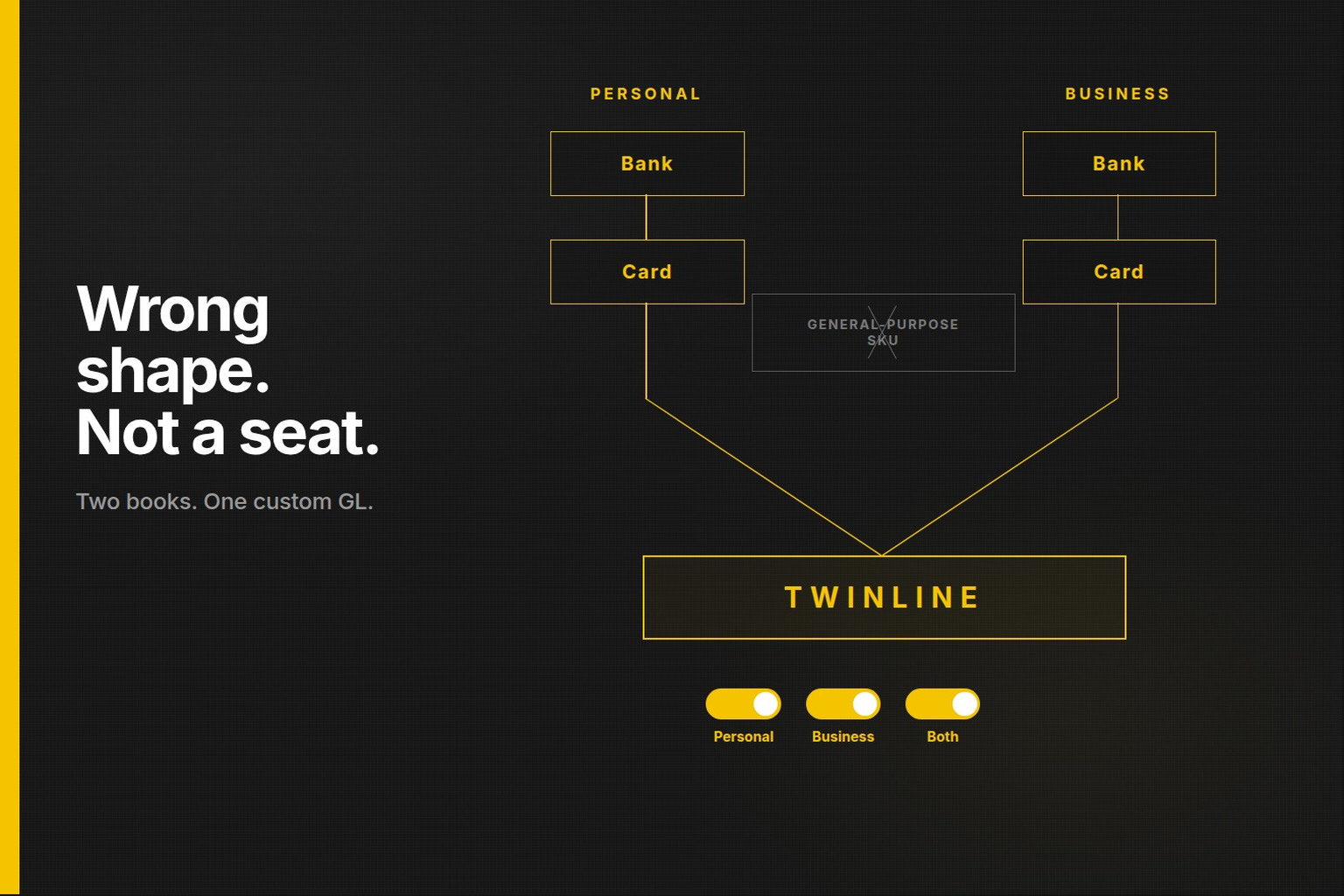
We run two books. Personal and business. Each side has its own bank and its own card. Contractor cadence. Housing lump. A SaaS stack that shows up as real envelopes of spend, not as a chart someone copied from a template.
That is a custom loop. It is not a seat.
So we are replacing the QuickBooks bill. The books move to a Grok Build custom GL we call Twinline, at accounts.pineapples.dev. International payments and payroll move to deals.com. Twinline records what happened. deals.com runs the payouts. Build agents ship the ledger. Marketing agents write this series. Same operator week to week.
If that sounds like an agentic workflow, it is because it is one. Named owner. System of record. Human gate on the exception. Not a chatbot. Not a prompt library. Not a dashboard demo with sample data.
This is not a listicle of vendors. It is the fit test we ran on our own books, and the loop we are standing up instead.
What QuickBooks was actually doing for us
Strip the brand. Ask what the SKU was for.
For us it was the rented general ledger: the place invoices, expenses, and "what did we spend" were supposed to live. It was also the place a mid-market operator is told to put payroll, vendors, and cross-border mess when they do not want to stand up their own books.
What it was not doing well is matching how Pineapples actually moves money:
- Two legal and practical rails that must not smear into each other unless someone deliberately says so
- Personal bank + card on one side, business bank + card on the other
- Recurring envelopes that come from real spend, not from a generic chart of accounts
- A contractor rhythm that is not the same thing as a W-2 payroll file living inside the GL SKU
A general-purpose GL is built to be everybody's books. We needed our books.
This post does not publish the invoice. Neo gates any dollar amount, vendor term, or live ledger figure before it goes public. The decision does not wait on a blog number. The shape of the problem is enough to kill the SKU.
Two books is the constraint, not a preference
Personal vs business is not a filter on a report. It is the architecture.
Each book has its own bank and card. Envelopes are cut from how money actually left those rails. Housing on the first. Biweekly contractor cadence. The SaaS stack as it shows up in spend. DoorDash as a cadence, not a morality lecture. The toggle is Personal / Business / Both, and Both is an operator choice, not the default smear.
If your GL cannot keep those rails honest, you will reconcile in spreadsheets forever. That is how a "cheap" seat becomes the expensive system of record: the truth leaks into files the SKU does not own.
Twinline is the answer we are shipping for that constraint. A later post in this series covers the product. This post only needs the constraint named, because the constraint is why the QuickBooks seat fails the fit test.
What we still need from a general ledger
Killing a bill is not the same as killing the job.
We still need:
- A system of record the operator trusts on Tuesday, not a mailbox, not three CSVs that disagree
- Envelopes that match real spend, so the budget is a map of the week, not a museum of categories
- A clean handoff to payroll and cross-border, the GL records; deals.com runs payouts
- A human gate on anything that commits money, named, not a rotating committee
That list is the job description for Twinline. It is also the three-test frame from our agentic workflows page, applied to our own books:
- Owner: Neo
- System of record: Twinline /
accounts.pineapples.dev(standing up fromapps/accounts) - Human gate: Neo on the exception, especially anything that moves money
If a draft of this story cannot name those three, it is a demo. We do not publish demos. Operators who cannot name those three yet should start with an AI readiness assessment, not another general-purpose seat.
Why "AI" is not the reason we are doing this
The market will try to read this as "we replaced accounting software with a chatbot."
That read is wrong.
We used coding agents to build a GL that fits the two-book loop. We use a marketing agent to write the operating story of that build. The model is labor inside an owned perimeter. The hero is not the model. The hero is the loop that still has a person on the miss. That is AI-native software delivery applied to our books, not a Copilot seat count.
A Copilot seat count is not this. A weekend agent that never writes back is not this. A vendor demo on sample data is not this.
If you cannot reconstruct last Tuesday's exception without the one person who knows the spreadsheet, you do not have a workflow. You have a conversation. We are done renting a conversation that pretends to be our books.
What this series is (and is not)
One post would be a case study. Five posts is the operating model:
- This post, the QuickBooks alternative for two books, and why a general-purpose SKU is the wrong shape
- Twinline, two books, envelopes from real spend,
accounts.pineapples.dev - deals.com, payroll and cross-border leave the GL SKU; Twinline records after the fact
- Agents on the same loop, issue → brief → draft → Neo gate →
content/blog/ - The savings, then the product, what we keep internal, what a mid-market operator can copy, pointed at live Fractional CTO / AI-Native Build fees on pineapples.dev. No invented case-study dollars.
Live fees on pineapples.dev stay the live fees. This series does not invent SKUs.
What still needs Neo's gate
- QuickBooks line items and any "savings" claim
- deals.com terms that would show up as public dollars
- Live ledger figures and seed data (the Twinline seed stays private)
Dollar amounts still need Neo before a savings claim appears later in this series. This post ships the shape of the problem without those numbers.
Frequently asked questions
What is a QuickBooks alternative for operators who need two books?
A QuickBooks alternative, for an operator who needs two books, is a general ledger that keeps personal and business rails honest. Each side has its own bank and card. Envelopes come from real spend. It is a custom loop, not another general-purpose seat. For Pineapples that loop is Twinline on accounts.pineapples.dev. Neo owns it. The human gate stays on anything that commits money.
Is this an AI chatbot replacing accounting software?
No. We used coding agents to build a GL that fits the two-book loop. We use a marketing agent to write the operating story of that build. The model is labor inside an owned perimeter. The hero is the loop that still has a person on the miss, not a chatbot, a prompt library, or a dashboard demo with sample data.
What is Twinline?
Twinline is the custom general ledger we are standing up under apps/accounts, hosted at accounts.pineapples.dev. It keeps personal and business rails honest, cuts envelopes from real spend, and records what happened after deals.com runs payroll and cross-border payouts.
Who owns the loop if something is wrong on a Tuesday?
Neo. Named owner, not a rotating committee. Neo gates the exception, especially anything that moves money. If a draft of this story cannot name the owner, the system of record, and the human gate, it is a demo. We do not publish demos.
When will you publish the dollar savings?
After Neo gates QuickBooks line items and any deals.com terms that would show up as public dollars. Live ledger figures and Twinline seed data stay private. This post ships the shape of the problem. A later post in the series is the only place a savings claim would appear, and only after that gate.
Working a live deal?
Book a 30-minute working session.
Same operator who runs the diligence engagements. No SDRs, no sales team. Bring the target, I'll bring the checklist.
Share this article
Anthony Wentzel
Founder, Pineapples
Anthony Wentzel has spent 26 years helping mid-market, PE, and family-office operators turn technology risk into decisions they can own. He is the founder of Pineapples.