
Why Every Tuesday Spiked 2M to 50M/hr: American Idol, Ad Splits, and a Custom CMS
Anthony Wentzel
Founder, Pineapples
Why Every Tuesday Spiked 2M to 50M/hr: American Idol, Ad Splits, and a Custom CMS
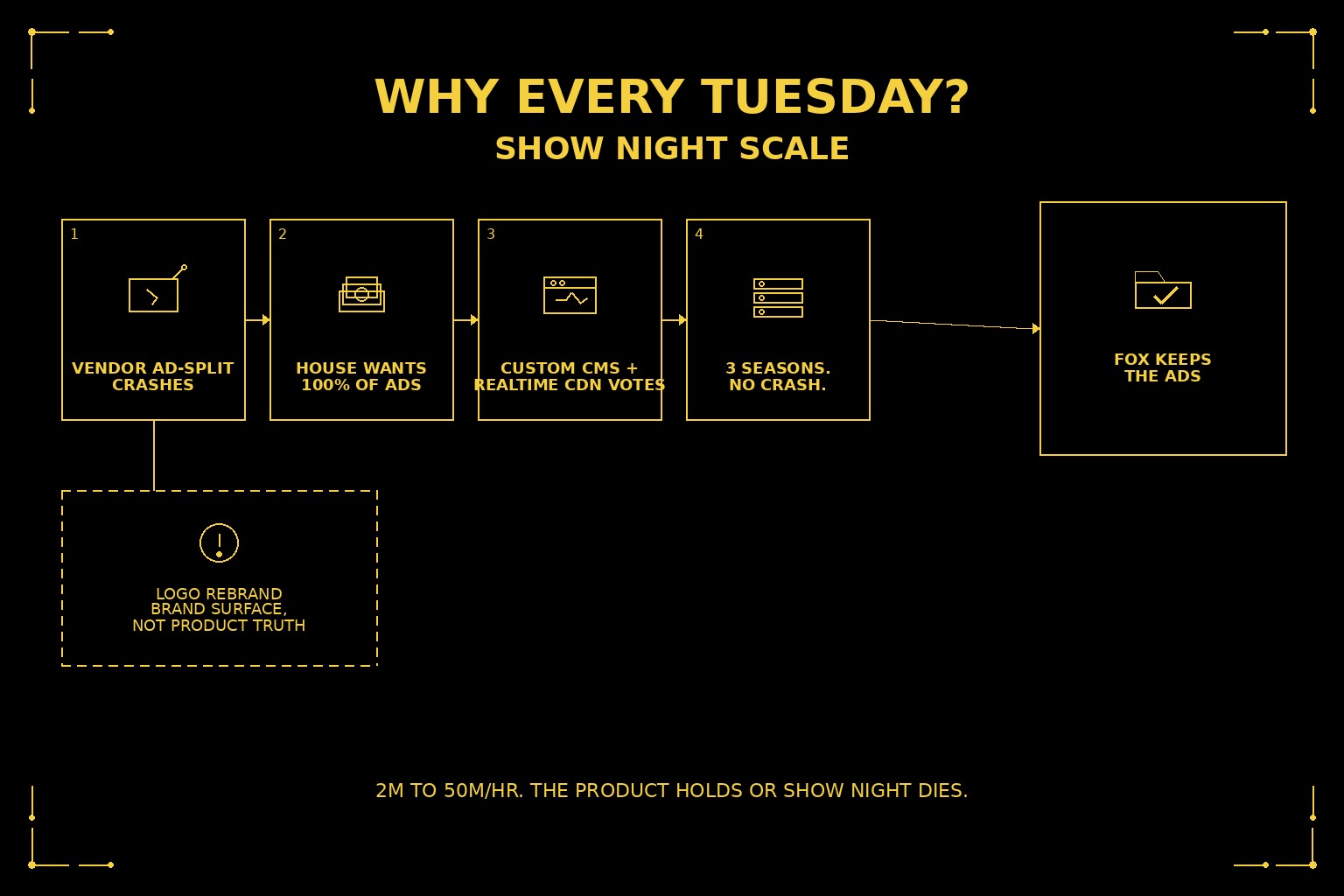
The Tuesday spike from 2M to 50M an hour was show night. Fox wanted about $50M checks by season 3 and 100% of the American Idol ad stack. A vendor ad-split site had already crashed. We rebuilt it as a custom CMS with realtime CDN votes. Three seasons migrated. No crash. Fox kept the ads.
I write this for the operator who is about to keep a vendor split on a night the house cannot miss, and for the PE or mid-market buyer who will own that night after close.
This is a named file. Fox. American Idol. The facts stay inside that file. I do not pad it with other logos.
Why did every Tuesday spike from 2M to 50M/hr?
I sat with Fox VP Engineering looking at the curve. Traffic went from about 2M to 50M an hour. He asked why every Tuesday looked like that.
It was not a mystery. It was American Idol on the air.
Show night is a different product than the rest of the week. The site has to take the audience that just heard the number on television. Votes have to land. Ads have to run. If either side dies, the house does not get the night.
A status page that is green on Monday does not answer that question. The VP was not asking for a dashboard. He was asking whether we understood the clock.
Software delays become operating risk when the slip sits on a revenue night. Show night is that class of file. A six-week polish that is not ready when the broadcast hits is not a polish. It is a miss.
Why did Fox want 100% of the ad stack?
The incoming site was a vendor ad-split. The vendor took a cut. The house did not own the full stack.
Fox wanted about $50M checks by season 3. That number only works if the house keeps the ads. It does not work if a vendor owns the split and the site falls over when the show goes live.
Crashes forced the rebuild. I do not treat that as a vendor-management footnote. If the product dies on show night, the revenue conversation is already over. You can argue about the split after the site holds. You cannot argue about the split while the site is down.
Software project rescue is the cousin when the current build is already slipping and the business still needs the night. This page is narrower. The diagnosis was not "add another status meeting." The diagnosis was "this stack cannot take show night, and the house cannot keep 100% of the ads on it."
A build versus buy scorecard will still ask whether a vendor is cheaper. Fine work when the product is a back-office tool. It is the wrong first question when the vendor already crashed and the house wants the whole ad stack. You are not choosing a catalog SKU. You are choosing whether the night belongs to you.
What does a custom CMS plus realtime CDN votes actually change?
The rebuild was a custom CMS and realtime CDN votes. Content the house could operate. Votes that could ride a CDN while the broadcast was live.
Three seasons migrated onto that stack. The product did not crash. Fox kept the ads.
That is the whole proof. I am not going to invent extra seasons, extra markets, or a traffic chart I do not have. Three seasons. No crash. The house kept the revenue control it asked for.
Custom software for mid-market is the 90-day mechanics cousin. This page is the night those mechanics have to survive. A CMS that cannot take a Tuesday spike is a brochure. Realtime votes that cannot ride a CDN are a demo. The object is the show, not the slide.
AI-native software delivery is the operating-model read for how a small owner-led team ships and stays on a file. The Idol rebuild predates that language. The test is the same. Same operator from the diagnosis to the seasons that actually ran.
Why did a rebrand dip traffic if the product was true?
Later, a logo change confused people. Traffic dipped.
The CMS still held. The votes still held. The product was not the thing that moved.
Product truth is not the same as brand surface. I keep those apart on purpose. A buyer who reads a traffic dip as "the stack failed" will fund the wrong repair. A buyer who reads a clean logo as "the stack is proven" will miss show night.
If the curve moved because people did not recognize the mark, that is a surface problem. If the curve moved because Tuesday took the site down, that is the product. Only one of those is a rebuild.
What should a mid-market or PE buyer take from show night?
I take four objects into the next operating meeting. I stop.
- Who owns 100% of the ad stack, or the equivalent revenue path, on the night it matters
- Whether the current vendor already crashed under live load
- Whether the product can take a known spike (here, 2M to 50M an hour on Tuesday) without becoming an incident
- Whether a later brand change is being mistaken for product truth
If those are clean, the vendor matrix can wait. If they are not clean, the vendor matrix does not matter yet.
AI-native retainers versus project shops is the commercial cousin. Show night is why continuity matters. A shop that leaves after the first season takes the memory of why Tuesday looks like that. The house still has the broadcast.
I run this as owner-led work. Same operator from the VP question to the seasons that did not crash. Not a deck shop. Not a split you cannot operate.
If you have a live file where the house wants the whole stack and the product cannot miss the night, start in chat. Bring the last crash and the person who still remembers the clock. I will sit with both. PE and mid-market seats that need the longer motion can read engagements.
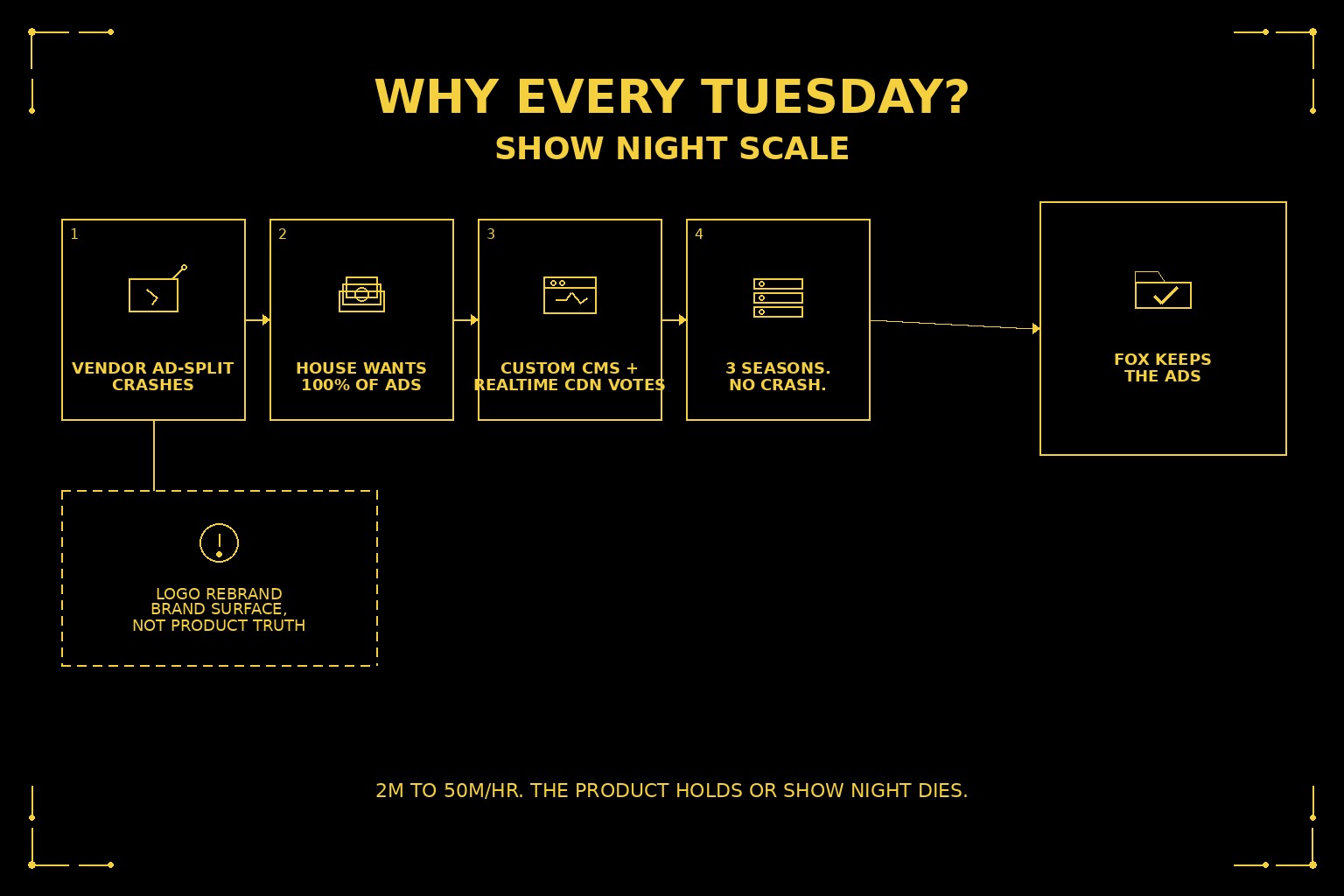
The diagram is the finding. A vendor split that already failed. A house that wants the ads. A custom CMS and realtime votes that have to hold. Three seasons. Fox keeps the ads. The rebrand is the side path. Do not confuse it with the product.
What do I take into the next operating meeting?
Who owns the ads on the night. Whether the last vendor already crashed. Whether Tuesday is still a surprise. Whether a logo dip is being treated as an engineering event.
If those are named, you have a file. If they are not named, keep the cash. The broadcast will not wait for another status deck.
Related reading
Frequently asked questions
Why did American Idol traffic spike every Tuesday?
The spike was show night. Traffic moved from about 2M to 50M an hour when the live broadcast hit. A VP of Engineering asked why every Tuesday looked like an incident. It was the show, not a random load test.
Why rebuild a vendor ad-split site instead of patching it?
The vendor site already crashed under live load. Fox wanted about $50M checks by season 3 and 100% control of the ad revenue. A patch on a stack you do not own cannot give the house the whole ad stack. The crashes forced a rebuild.
What did the custom CMS and realtime CDN votes change?
The rebuild put content and live voting on a custom CMS with realtime CDN votes. Three seasons migrated. The product did not crash on show night. Fox kept the ads.
Why did a later rebrand dip traffic if the product was stable?
A logo change confused people who already knew the product. Traffic dipped even though the CMS and votes still held. Product truth is not the same as brand surface. Do not read a logo dip as an engineering failure.
What should a mid-market or PE buyer take from show-night scale?
If the house wants 100% of the ad stack, the product cannot crash on the night the revenue happens. A vendor split that already failed is a rescue, not a roadmap. Start with the live file in chat if that is the seat you are in.
Working a live deal?
Book a 30-minute working session.
Same operator who runs the diligence engagements. No SDRs, no sales team. Bring the target, I'll bring the checklist.
Share this article
Anthony Wentzel
Founder, Pineapples
Anthony Wentzel has spent 26 years helping mid-market, PE, and family-office operators turn technology risk into decisions they can own. He is the founder of Pineapples.